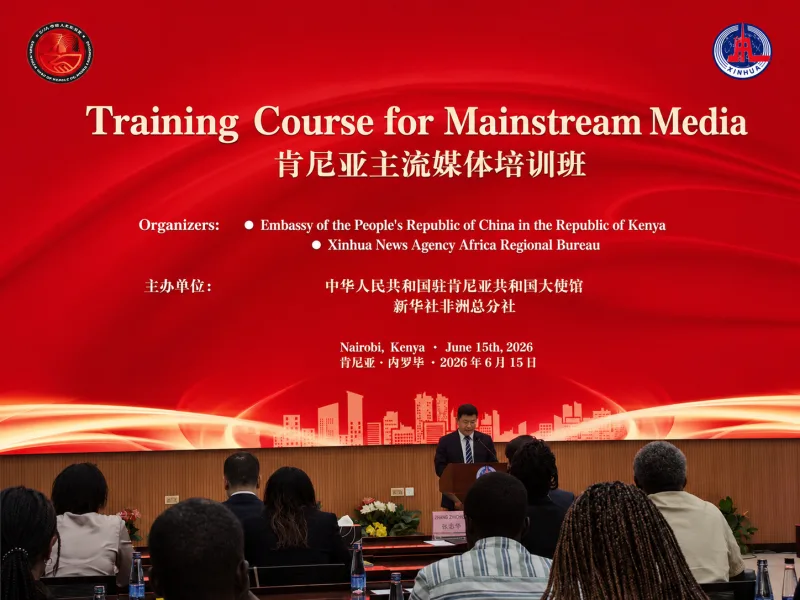
NAIROBI, Kenya June 16 – Kenyan Journalists and media practitioners from across the region gathered in Nairobi for a media training seminar organized by the Xinhua News Agency Africa Regional Bureau, where participants explored how artificial intelligence and visual storytelling are reshaping modern journalism.
The training brought together reporters, editors, producers and media professionals to examine practical ways of integrating emerging technologies into newsroom operations while safeguarding journalism’s core values of truth, verification and public service.
Held at Xinhua’s Africa regional bureau offices in Nairobi, the seminar focused on two key themes: the application of artificial intelligence in news production and the use of visual storytelling techniques in documentary filmmaking.
Throughout the sessions, speakers emphasized that while technological innovations are transforming the media landscape, human editorial judgment remains indispensable.
Opening the seminar, Chinese Embassy in Kenya Minister Counselor Zhang Zhizhang said the training formed part of broader efforts to strengthen media cooperation under the China-Africa Year of People-to-People Exchanges.
He noted that emerging technologies have fundamentally altered how news is produced, distributed and consumed, presenting both opportunities and challenges for media organizations worldwide.
“Emerging technologies have fundamentally transformed how news is gathered and distributed,” Zhang said. “This training seminar provides a vital platform for sharing knowledge, practical experience and best practices to help reinvent the industry and strengthen our media cooperation.”
Zhang warned that the rise of artificial intelligence and digital platforms has created an environment where misinformation can spread rapidly and where audience traffic increasingly competes with journalistic integrity.
“When false information can pass for truth and traffic becomes the only standard, the core value of media professionals, the pursuit of truth and the verification of information, is steadily weakened,” he said.
He stressed that journalism must remain rooted in objective reporting and verification regardless of technological advancements.
“Truth remains the foundation of journalism,” he said, adding that media organizations have a responsibility to report both challenges and stories that reflect development and social progress.
Xinhua News Agency Africa Regional Bureau Director General Ying Qiang echoed similar sentiments, emphasizing that professional journalism must continue serving the public interest.
“Truth is the lifeblood of journalism. We insist on in-depth investigation and objective verification, striving to present a full picture of the facts,” Ying said.
He cautioned against reducing journalism to a business driven solely by clicks and profits.
“We believe that media should serve the people, not capital. News reporting is not a commodity or a tool for gaining traffic or profit. Rather, it is a means of conveying information, serving the public and promoting social progress,” he added.
A significant portion of the training focused on the practical application of artificial intelligence in newsroom workflows.
During the technical sessions, Yang Dingdu demonstrated how AI-powered tools can support journalists throughout the editorial process, from background research and transcription to fact-checking and copyediting.
“AI is a very important learning tool,” Yang said. “If you have a topic that you need to work on today and tomorrow you work on another topic, you need to very quickly get familiar with that topic. AI is a very powerful tool for helping journalists understand new fields rapidly.”
Participants shared their own experiences using AI-powered platforms such as ChatGPT, Claude, Gemini and NotebookLM to improve productivity and enhance newsroom efficiency.
Monica, an editor at Citizen TV, described the traditional editorial process that involves researching topics, identifying news angles and refining scripts before publication. Yang later demonstrated how artificial intelligence could automate parts of that workflow while still requiring human oversight to ensure accuracy and fairness.
The training emphasized that automation should complement rather than replace journalists, allowing newsrooms to devote more resources to investigative and enterprise reporting.
The seminar also explored the growing importance of visual storytelling in modern journalism.
Leading the session on documentary production, Xinhua journalist and documentary director Wu Di encouraged participants to focus on human-centered storytelling when covering complex issues such as development, climate change and international cooperation.
“We are living in a remarkable time. Today artificial intelligence is transforming the way we work, create and communicate,” Wu said.
However, she argued that technology alone cannot replace the emotional connection created through compelling storytelling.
“One of the challenges we face as journalists is dealing with large topics. Development, economic growth, infrastructure, climate change and international cooperation are important topics, but they are also abstract,” she said.
According to Wu, the most effective documentaries translate broad policy discussions into relatable human experiences.
“The human story is a bridge between information and emotion, and emotion is what creates memory,” she noted.
The final session focused on documentary aesthetics and video editing, with media trainer James Asande demonstrating how digital tools can help journalists transform written content into engaging visual products.
Asande showed participants how automated design platforms and visualization software can assist editors in planning story structures, producing graphics and simplifying complex information for audiences.
“Visualizing is also a very important tool to help you learn a topic,” Asande said.
As the media industry continues to adapt to rapid technological change, participants left the seminar with a common message: artificial intelligence may be transforming newsroom operations, but journalism’s enduring value remains anchored in truth, verification, ethical reporting and human judgment.
The Nairobi training underscored the growing need for journalists to embrace innovation while ensuring technology remains a tool that strengthens, rather than undermines, the profession’s fundamental responsibility to inform the public accurately and responsibly.