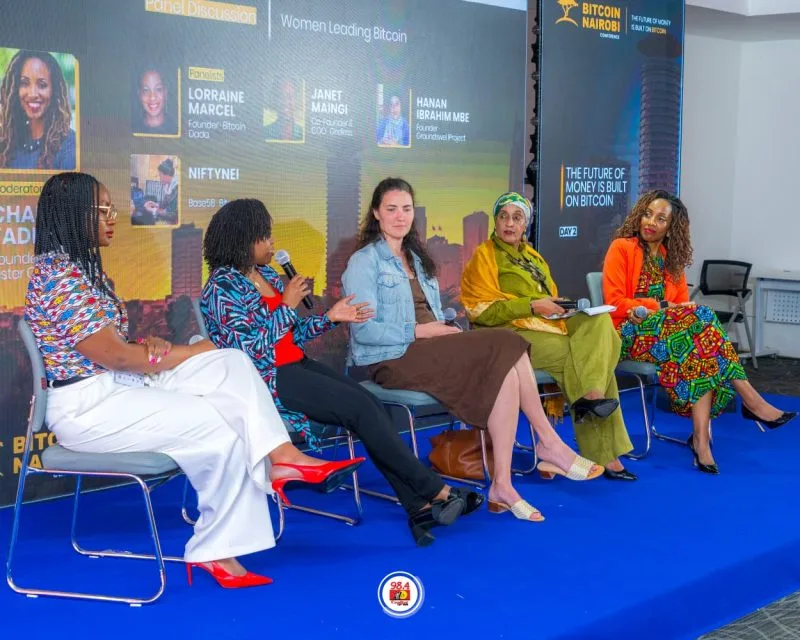
NAIROBI, Kenya, June 25 – Women leaders in the global Bitcoin ecosystem have called for greater investment in grassroots infrastructure, developer training and community-led initiatives, arguing that access to capital remains one of the biggest barriers to building a sustainable digital economy across Africa.
Speaking during the second day of the Adopt Bitcoin Conference in Nairobi, industry leaders said while Bitcoin adoption is growing across the continent, funding continues to flow disproportionately towards products and startups, leaving behind the educational and technical infrastructure needed to develop future talent.
Bitcoin Dada founder Lorraine Marcel said bridging the gap between global Bitcoin funding networks and local investors will be critical in ensuring African innovators can fully participate in the sector.
“A lot of people prefer funding products as opposed to funding the infrastructure. But it’s the infrastructure that produces these developers, creatives and leaders,” Marcel said.
“We need to bridge the gap between the global Bitcoin ecosystem of funds and local capital. That’s how we maintain the quality of talent and innovation coming out of Africa.”
Her remarks come as African Bitcoin communities increasingly seek long-term financing models that can support training, research and open-source development, rather than focusing solely on commercial applications.
Industry players argued that stronger investment in talent pipelines could help position Kenya and the broader region as hubs for Bitcoin innovation at a time when digital assets are attracting growing attention from investors, policymakers and technology entrepreneurs.
Janet Maingi, co-founder of Gridless, challenged perceptions that technical roles are the only pathway into the Bitcoin industry, saying the sector offers opportunities across multiple disciplines.
“People need to get out of the mindset that Bitcoin mining means you have to be an engineer. There are many more opportunities within the space,” Maingi said.
Her comments highlighted a broader conversation around workforce diversity in emerging technology sectors, where women remain underrepresented despite growing demand for skills in operations, communications, customer support, finance and product development.
Meanwhile, Bitcoin++ founder Nifty Nei emphasized the importance of inclusion and mentorship in retaining women within the ecosystem, noting that deliberate efforts to make newcomers feel welcomed can significantly improve participation.
“One of the hardest things about being a woman in technology is sometimes feeling like your work is not recognized,”Neigut said.
“Making sure people know they are seen, valued and wanted in the space is one of the biggest things we can do to encourage participation.”
Neigut also stressed that sustainable funding remains essential for open-source Bitcoin development, where many developers often contribute in their spare time without dedicated financial support.
The discussion also highlighted the role of grassroots organizations in creating pathways for women and young people to enter the technology sector.
Hanan Ibrahim, founder of the Groundswell Project, pointed to community-based initiatives that are helping equip young women with digital skills and confidence to participate in the future economy.
“There are so many people doing good work at the grassroots level, but they remain underfunded,” Ibrahim said.
“The important work is helping communities build the confidence and skills needed to participate in the future economy,”she added.
The conference discussions reflected a growing consensus that expanding women’s participation in Bitcoin will require more than education and advocacy.
Speakers argued that unlocking capital for community organizations, developer training and mentorship programmes could prove just as important as technological innovation itself.
As Bitcoin adoption gains traction across Africa, industry leaders say the next phase of growth will depend on whether the ecosystem can build stronger funding mechanisms that support both innovation and the people behind it.