NAIROBI, Kenya, Sep 6— The Bezos Earth Fund has announced a USD22.8 million to accelerate the restoration of two African landscapes critical for carbon sequestration, biodiversity and human well-being.
The funding initiative will focus on the Greater Rift Valley in Kenya and the Lake Kivu and Rusizi River Basin in the Democratic Republic of Congo, Rwanda, and Burundi.
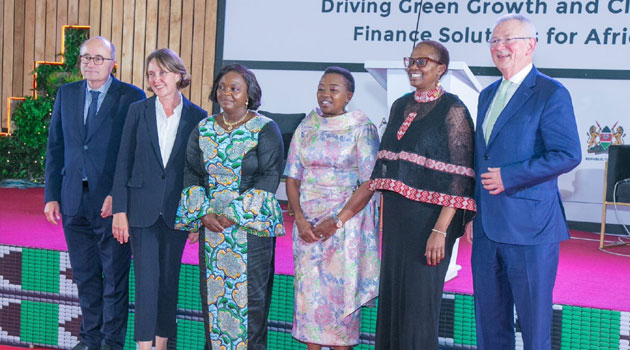
Bezos Earth Fund’s President and CEO, Andrew Steer, made the announcement during the Africa Climate Summit held in Nairobi on Tuesday.
The announcement followed calls from Kenya’s First Lady, Rachel Ruto, and Second Lady, Dorcas Rigathi, highlighting the pivotal role of restoration in empowering vulnerable populations to transform their landscapes and livelihoods.
First Lady Ruto also announced plans to rally African First Ladies as champions of grassroots, women-led restoration efforts across the continent.
The funding is part of the Earth Fund’s $1 billion commitment to landscape restoration globally.
It also adds to the $42.2 million granted previously to accelerate Africa’s restoration movement, known as AFR100, and complements recent funding from The Audacious Project and Norway’s International Climate and Forest Initiative (NICFI).
Dr. Steer emphasized Africa’s significance in the global fight against climate change, biodiversity loss, and poverty,
“Africa is home to the world’s largest restoration opportunity and is a critical player in the global fight against climate change, nature loss, and poverty,” he said noting that thirty-four African countries have put forward an ambitious vision to restore 100 million hectares of degraded land by 2030.
“With these grants we are proud to support the next generation of African institutions that are at the heart of the continent’s restoration movement and begin the vital work of leveraging philanthropy into private investment in restoration.”
The grants, which are still in process, will enable the restoration of 600,000 hectares of degraded land in the Greater Rift Valley, home to Kenya’s water towers and a breadbasket for the region, and the Lake Kivu and Rusizi River Basin, part of the second-largest rainforest in the world and home to five million people.
Restoration at this scale can sequester 42 million metric tons of carbon dioxide equivalent by 2050, the equivalent of taking more than 9.3 million gasoline-powered vehicles off the road per year.
The grants will provide technical assistance to community groups and restoration enterprises in both landscapes.
This support will focus on remote sensing, restoration techniques, nursery management, marketing, and financial management.
It will also provide multi-year organizational development support to grassroots African restoration organizations.
The fund will further Strengthen value chains for products and services produced through restoration and attract development finance, public funds, and private investment into restoration projects and businesses.
It will also monitor land cover changes and restoration impacts using data from land and Carbon lab.
On her part, Wanjira Mathai, the Earth Fund’s advisor for Africa and Managing Director at the World Resources Institute said, locally led and managed restoration efforts are more likely to deliver long term success and can bring climate and biodiversity benefits along with economic prosperity for communities.
“The bottom line is without local leadership, local wisdom, and passion, scaling restoration across Africa would be impossible,” she said.
“Already, Africa is home to some of our planet’s greatest restoration successes, and this funding will support locally led restoration to re-green our beautiful African continent.”
Mamadou Diakhité, Head of the Climate Change and Environmental Sustainability Division at the African Union Development Agency (AUDA-NEPAD) and lead of the AFR100 Secretariat on her part said that Africa is at the forefront of the restoration economy.
Thousands of entrepreneurs across the continent are demonstrating that landscape restoration is not just good for the environment but creates jobs and generates economic returns.
“These kinds of green jobs are essential for Africa’s youth. Africa is a young continent and an entrepreneurial one. We are ready for investment.” Diakhité said.
The Bezos Earth Fund is transforming the fight against climate change with the largest ever philanthropic commitment to climate and nature protection.
The Fund is investing $10 billion to protect nature and drive systems-level change, creating a just transition to a low-carbon economy.