NAIROBI, Kenya, Nov 19 – Honing a skill in the distillery industry can be a tough adventure. This is because there are fewer brewers in Kenya.
Since the field is dominated by men, women find it even harder to break the glass ceiling.
Competition is especially high at big firms such as Kenya Breweries Limited (KBL) and East African Breweries Limited (EABL) compared to smaller ones, which are a handful in the country.
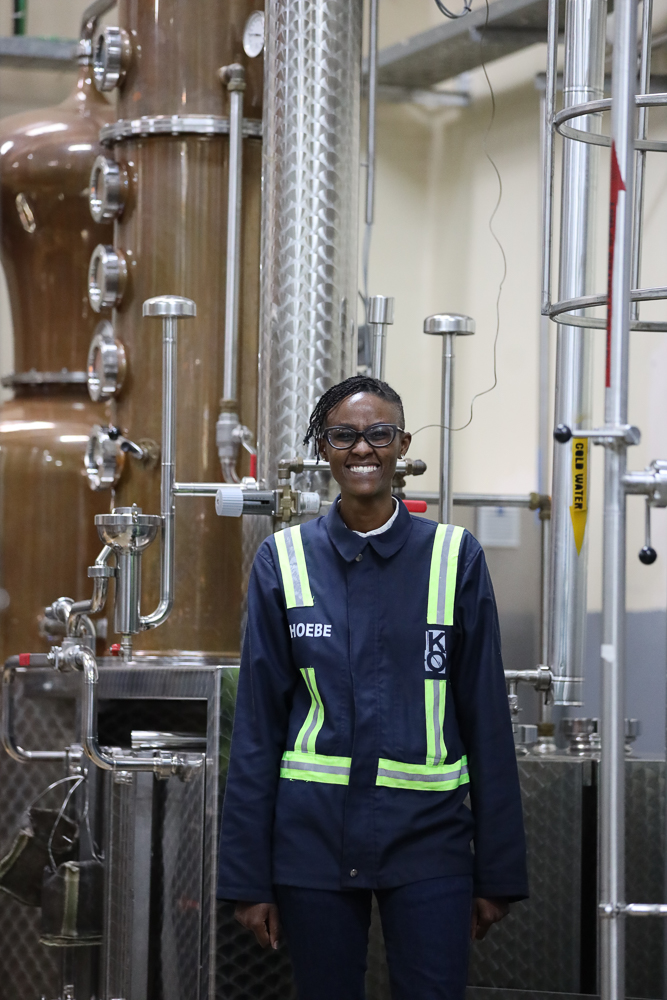
Phoebe Kiboi is one lucky woman who got a distillery work opportunity at Kenyan Originals (KO) or African Originals, a local firm that specialises in crafted alcoholic beverages.
Kiboi first came to know the KO brand at a music festival three years ago, and what intrigued her about the company then was its vibe.
“I always wanted to be a distiller since I started my career in the spirits industry but there were no such opportunities in the Kenyan industry,” the 31-year-old says.
“It is only recently when a few companies have brought the craft to Kenya, Kenyan Originals being a pioneer in the space,” she adds.
However, Kiboi had to study industrial chemistry at the university to hone her skills.
From then, she has accumulated five years’ experience in spirit production under quality, control, and assurance.
“I have also worked as a Quality Analyst and a Blending technician.”
At its factory in Baba Dogo, Nairobi, KO makes drinks from Kenyan-sourced ingredients.
“We use a wide variety of locally sourced botanicals; from the spices that we use in our diverse local cuisines, to the fruits and vegetables we grow and eat from different regions,” she said.
“We also use exquisite flowers, leaves, roots and barks of trees grown in Kenya. We have different botanicals in our different gins.”

Its gins, which have about 5.8 percent alcohol content, use raw materials such as groundnuts, mabuyu (baobab), mint, and limes from cider production.
“On the other hand, with KO Gin we use specialty botanicals from all over kenya including Bitter Orange leaves from Kilifi, pink peppercorns sourced from Naivasha and organic roses from the slopes of mount Kenya offering our consumers a flavour safari,” she says.
“In some of our gins, including KO Purple Haze, we also use African Juniper, which is indigenous to kenya.”
So, how are KO drinks made?
The distillation process at KO is intriguing. It encompasses creating unique product profiles from an array of locally sourced ingredients that are succinct to the Kenyan palate and culture.
“At KO, we are deeply rooted in the craft scene which has inspired us to use a variety of traditional and new methods for each of our gins,” Kiboi adds.
“Some we macerate (where you steep ingredients in the spirit) botanicals before, some we macerate after. All our gins, however, are still distilled on our beautiful copper pot still.”
Her role entails curating liquids that can rival internationally acclaimed brands.
This is where her creativity comes in at the factory in Baba Dogo, Nairobi.
“All our gins are distilled by our amazing team of Kenyan distillers. Originality is at the heart of our day to day at African Originals. It means stepping into the distillery as a giant innovation center.”
“We are constantly trying new ingredients and new flavors. Our KO Klub range, as an example, is a range of gins which we only make around 200 of every flavour and launch a new flavour every 4 months.”
As part of the KO KLUB range, they have launched Coastal Spices, Pineapple, Cacao, and Very Berry Gins.
Led by head distiller Cheriuyot Ian, Kiboi works with the other two women.
“Collaboration is a key value at the company and as a result we are constantly innovating and collaborating with other local craft brands to bring new, exciting and curated products,” she explains.
“We recently collaborated with Muthaiga Tea Company to create a small batch distillation of KO X Purple Haze Gin.”