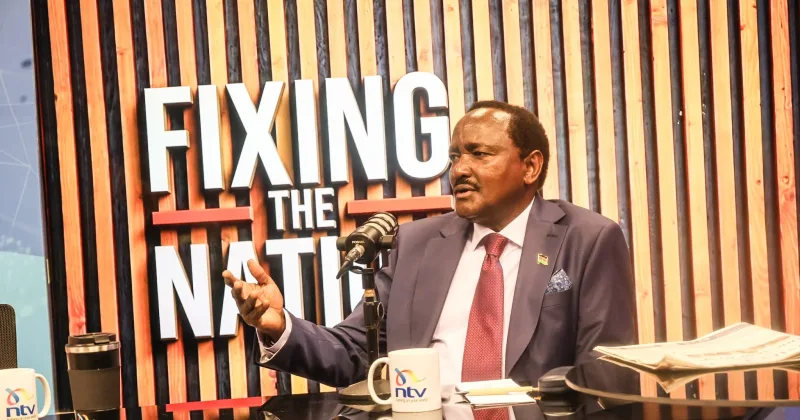
NAIROBI, Kenya, Aug 10 – Wiper leader Kalonzo Musyoka has cautioned the United Opposition against relying on opinion polls to determine its 2027 presidential ticket, warning that surveys could be used to manipulate voters and influence the outcome of the opposition’s internal negotiations.
Kalonzo said the opposition must approach polling data scientifically and avoid allowing numbers published by pollsters to dictate who should lead the coalition into the 2027 General Election.
“I think we must be very scientific about these opinion polls. I don’t want Kenyans to fall prey to electoral manipulation,” Kalonzo said.
He claimed there could be attempts by individuals within the intelligence community to influence public opinion through polling figures in a manner favourable to President William Ruto, although he did not provide evidence to support the allegation.
“Remember, there’s a third player called the intelligence community, which, in order to help William Ruto, may want to put up certain numbers,” he said.
Kalonzo said the opposition would not allow itself to be dictated to by what he described as manipulated opinion polls.
“This time we are not leaving anything to chance,” he said, adding that the opposition would remain united regardless of the numbers being circulated.
His remarks come amid an increasingly competitive contest over the composition of the opposition presidential ticket, with Kalonzo, former Interior Cabinet Secretary Fred Matiang’i, former Deputy President Rigathi Gachagua and Nairobi Senator Edwin Sifuna emerging as key figures in the negotiations.
Recent opinion polls have produced different combinations of the leading opposition figures, underscoring the lack of consensus on who should occupy the presidential and deputy presidential slots.
A TIFA Research survey released in May found that, among supporters of opposition candidates, a Kalonzo Musyoka-Fred Matiang’i pairing was the most preferred combination at 31 per cent, followed by Kalonzo-Sifuna at 28 per cent and Gachagua-Kalonzo at 25 per cent. The survey tested the pairs without specifying which candidate would be president and which would be deputy president.
The latest Infotrak Voice of the People poll, however, produced a different picture.
The survey placed a Kalonzo-Sifuna ticket at the top with 23 per cent support, followed by Kalonzo-Matiang’i at 16 per cent and Matiang’i-Kalonzo at 15 per cent.
Other combinations tested included Kalonzo-Gachagua at five per cent, Gachagua-Kalonzo at four per cent, Gachagua-Matiang’i at four per cent, Matiang’i-Gachagua at four per cent and Kalonzo-Martha Karua at three per cent. A significant 21 per cent of respondents were unsure or declined to choose a ticket.
The Infotrak survey also found Kalonzo leading the opposition field as the preferred presidential candidate at 27 per cent, narrowly ahead of Matiang’i at 26 per cent and Sifuna at 19 per cent. Gachagua followed at nine per cent, while 10 per cent were undecided.
Kalonzo questioned the value of using such figures to settle what he described as a complex political question.
Asked whether he would support a Sifuna-led ticket if the Nairobi senator emerged as the preferred candidate, Kalonzo said he had no difficulty supporting him, but stressed that the decision could not be based on numbers alone.
“I have no problem at all,” Kalonzo said.
He said the opposition would have to consider Kenya’s demographic and political realities, arguing that communities across the country expected to have a stake in government.
“It is not just a simple question of numbers. You have to take into account the complexity of the Kenyan demographic architecture and the expectations of Kenyans from every corner of the republic,” he said.
Kalonzo said he had demonstrated his willingness to support other opposition leaders, pointing to his backing of Gachagua during his political fallout with President Ruto.
He also said he would be willing to support other opposition figures, including Sifuna, Gachagua, former Defence Cabinet Secretary Eugene Wamalwa, former Justice Minister Martha Karua and Matiang’i, if the coalition agreed on them as its preferred candidate.
“I have no problem supporting him. I have no problem supporting Gachagua. I have no problem supporting Eugene Wamalwa, Martha Karua, my twin sister as well,” he said.
Kalonzo said the overriding objective should be to maintain the unity of the opposition rather than allow competition for the presidential ticket to tear the coalition apart.
“We are a team. The only important thing is we are aware that William Ruto’s only way to survival is to divide the United Opposition, the United Alternative Government,” he said.
“If we succeed in holding together, it matters not who is actually the flag bearer. It’s a common cause,” he added.
The remarks come as opposition leaders continue efforts to build a broad alliance ahead of the 2027 election, with the question of the presidential flagbearer emerging as one of the coalition’s biggest challenges.
The latest TIFA research also shows the race remains fluid. In its June 2026 national survey, TIFA found Sifuna at 15 per cent among presidential aspirants, followed by Matiang’i at 14 per cent, Kalonzo at 13 per cent and Gachagua at seven per cent, while 20 per cent of respondents remained undecided.
Infotrak’s July survey similarly showed a fragmented opposition field, with Kalonzo at 13 per cent nationally, while Sifuna and Matiang’i each recorded 12 per cent. Sifuna, however, posted his strongest support among young voters, recording 20 per cent among those aged 18 to 26.
The contrasting results have added another layer to the debate over how the opposition should select its candidate, with Kalonzo now warning that polling numbers should not be allowed to become a substitute for negotiations, political strategy and a broader national calculation.
He said the opposition’s priority should be to remain united and prevent President Ruto from exploiting divisions among its leading figures.
Kalonzo’s position could further complicate the race for the opposition ticket, particularly as different camps seek to interpret the polls as evidence of their preferred candidate’s national appeal.
For now, the Wiper leader maintains that the opposition should first preserve its unity and agree on a common political cause before determining who ultimately takes the top position on the ticket.