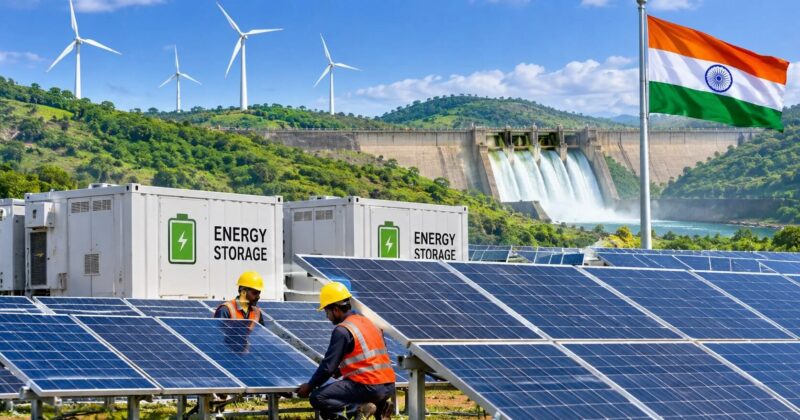
Nov 9 – India has approved a $1.5 billion (approximately Sh193 billion) scheme to develop 92 gigawatt-hours (GWh) of grid-scale energy storage capacity over the next five years, as the country seeks to strengthen energy security and accelerate its transition to renewable power.
The scheme, approved by Prime Minister Narendra Modi’s government, will support the development of new storage projects between the 2026-27 and 2030-31 financial years.
The planned capacity includes 60 GWh of pumped hydro storage, 30 GWh of battery storage and a further 2 GWh from emerging storage technologies.
According to the government, the additional capacity will be equivalent to about 170 per cent of India’s existing grid-scale energy storage capacity.
The initiative is expected to attract investments of approximately $10 billion over the next five years.
Announcing the approval on X, Modi said the investment would improve electricity reliability, support greater integration of renewable energy and strengthen the country’s energy security.
“The Cabinet has approved a massive Rs 14,500 crore push to develop 92 GWh of energy storage capacity, supporting an estimated investment of almost 1 lakh crore,” he said.
“Truly, it is more reliable power, greater renewable energy integration and stronger energy security,” he added.
Energy security and climate ambitions
India’s investment comes as the world’s most populous country seeks to reduce its vulnerability to disruptions in global energy markets while meeting rising domestic electricity demand.
Recent geopolitical tensions and disruptions to fuel supplies have highlighted the risks associated with dependence on imported energy, reinforcing the need for more diversified and resilient power systems.
The country has committed to achieving net-zero emissions by 2070 and installing 500 GW of electricity capacity from non-fossil fuel sources by 2030.
However, India remains heavily dependent on coal to meet the energy needs of its population of more than 1.4 billion people.
It is the world’s third-largest greenhouse gas emitter after China and the United States, according to the United Nations Environment Programme (UNEP).
India’s greenhouse gas emissions reached approximately 4.5 billion tonnes of carbon dioxide equivalent in 2025, excluding land use and forestry, according to UNEP’s Emissions Gap Report 2026.
Its per capita emissions, however, stood at 3.1 tonnes, less than half the global average of 6.4 tonnes.
The government is also targeting a 45 per cent reduction in emissions intensity by 2030, compared with 2005 levels. Emissions intensity measures the amount of greenhouse gases released for every unit of economic output.
Closing the renewable energy storage gap
India has made significant progress in expanding its renewable energy capacity, particularly solar power.
More than half of its installed electricity capacity came from non-fossil fuel sources as of July 2026, according to government data.
The country had approximately 171 GW of installed solar capacity by September, while its combined large and small hydropower capacity stood at about 57 GW, according to the Ministry of New and Renewable Energy.
Solar installations are concentrated in states including Rajasthan, Gujarat, Maharashtra, Tamil Nadu and Karnataka. Hydropower projects are largely located in Himalayan states such as Himachal Pradesh and Uttarakhand, as well as parts of coastal Karnataka.
Despite the expansion, energy storage remains a major challenge in India’s transition to cleaner electricity.
The government estimates that the country will require approximately 411 GWh of grid-scale storage capacity by 2031-32. This includes 236 GWh of battery storage and 175 GWh of pumped hydro storage.
However, only about 9.1 GWh of battery storage capacity was operational by September 2026, according to the Centre for Research on Energy and Clean Air.
This represents less than four per cent of the battery storage capacity projected to be required by 2031-32.
Energy storage is essential because renewable sources such as solar and wind do not generate electricity consistently throughout the day.
Solar power generation typically peaks during daylight hours, while electricity demand often rises in the evening as solar output declines.
Without adequate storage, excess electricity generated during periods of high renewable output can go unused, forcing power companies to rely on conventional sources, including coal-fired plants, to meet demand.
Pumped hydro storage and battery systems can help address this imbalance by storing surplus electricity and releasing it when demand rises or renewable generation falls.
Boosting domestic manufacturing
The government said the new scheme would also support local manufacturing of battery energy storage systems, reduce dependence on imports and strengthen long-term energy security.
Battery storage projects supported under the initiative will be required to meet a minimum domestic content threshold of 40 per cent.
The investment forms part of India’s broader strategy to develop domestic supply chains for technologies critical to its energy transition.
The government has separately approved a $300 million scheme to establish four domestic processing plants for lithium and nickel.
Both minerals are essential components in electric vehicle batteries, energy storage systems and various electronic products.
India currently relies heavily on imports of processed critical minerals, leaving its clean energy and manufacturing ambitions exposed to supply chain disruptions.
Developing local processing capacity is expected to reduce that dependence while supporting the country’s ambitions to expand renewable energy, electric mobility and battery manufacturing.