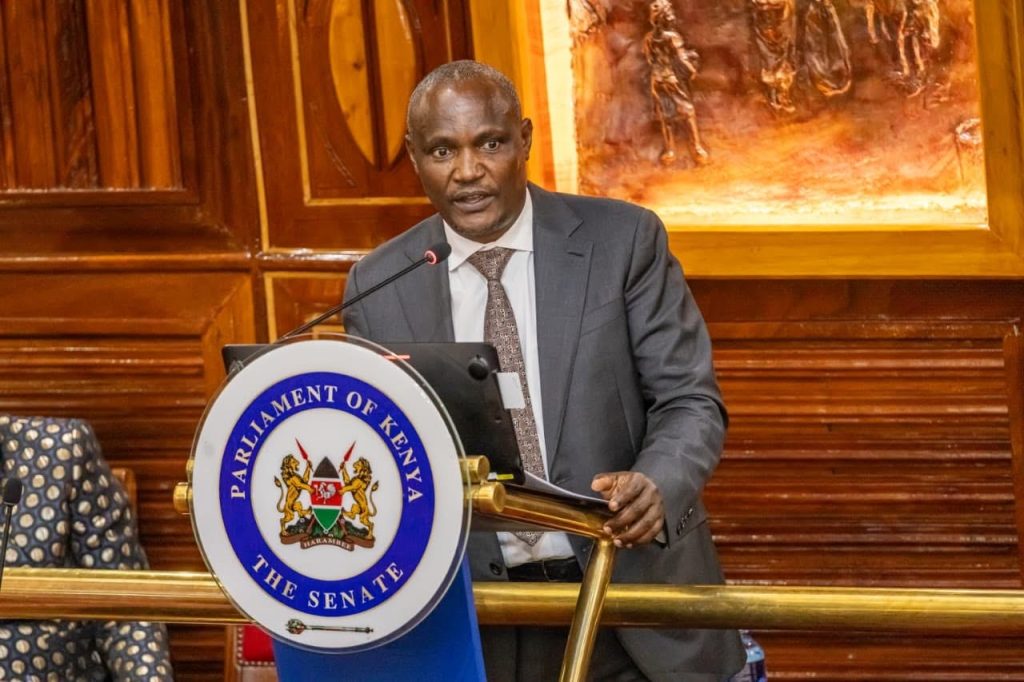
NAIROBI,Kenya Feb 25-The Government has stepped up efforts to restore order in fast-growing digital credit market, with the National Treasury outlining sweeping regulatory and policy measures aimed at curbing rogue lenders and protecting borrowers from predatory practices.
Appearing before the Senate on Wednesday, Cabinet Secretary for the National Treasury and Economic Planning, John Mbadi detailed the interventions in response to questions raised by Kisumu Senator Tom Ojienda and posed on his behalf by Bungoma Senator Wafula Wakoli.
Among the reforms the CS said, is a strengthened licensing and oversight regime spearheaded by the Central Bank of Kenya (CBK), which now requires all Non-Deposit Taking Credit Providers (NDTCPs) to be licensed under a comprehensive Digital Credit Providers regulatory framework.
The framework spells out strict eligibility criteria, governance standards, operational requirements and consumer protection obligations designed to clean up a sector that has in recent years faced mounting complaints over exorbitant interest rates, data misuse and unethical debt collection tactics.
“These measures have been introduced to ensure compliance with the law and most importantly to safeguard customers’ interests and prevent rogue lending institutions from infringing consumer rights,” CS Mbadi told Senators.
Data Protection Rules
The CS revealed that the CBK is working closely with the Office of the Data Protection Commissioner to enforce uniform data privacy standards across digital lenders.
Under the current framework, all licensed NDTCPs must fully comply with the Data Protection Act and its regulations.
As a pre-licensing requirement, lenders must obtain a certificate under Section 19 of the Act from the data protection authority and develop a comprehensive data protection policy.
“That policy must clearly set out how personal data is collected, processed, stored and protected, and must align with lawful, fair and transparent practices under the Act,” CS Mbadi said.
He noted that the licensing regime has already played a critical role in weeding out non-compliant operators and curbing predatory lending behaviour by ensuring only regulated entities remain in the market.
Lending Market
Providing an update on the structure of the credit market, CS Mbadi said the CBK currently licenses three categories of institutions to lend to the public: 38 commercial banks, 14 microfinance banks and 195 non-deposit-taking credit providers.
Oversight is conducted under the Banking Act, the Microfinance Act and the CBK Act, which govern entry into and conduct within the financial sector.
As of December 2025, credit to the private sector stood at Sh4.37 trillion from commercial banks, Sh32.7 billion from microfinance banks and Sh110.5 billion from digital credit providers.
“This represents 96.8 per cent, 0.8 per cent and 2.4 per cent of total credit advanced by these institutions respectively,” he disclosed.
In a separate response to Senator Ojienda, the CS updated the House on the status of economic and social programmes aimed at reducing poverty and cushioning households from hardship.
He said successive Medium-Term Plans have prioritised both direct and indirect poverty interventions.
Direct measures include social transfers, while indirect strategies involve macroeconomic policies such as interest rate adjustments to stimulate economic activity.
In December 2024, the CBK reduced its benchmark interest rate from 13.0 per cent to 11.25 per cent, a move CS Mbadi said led to a 1.4 per cent increase in credit advanced by commercial banks and non-bank financial institutions to Sh7.14 trillion by the end of that year.
Lower interest rates, he argued, enhance access to credit for small and medium-sized enterprises and households, boosting incomes and supporting economic growth.
The CS pointed to measurable gains across social protection, agriculture, health and education.
Secondary school enrolment, he said, has risen steadily from 3.26 million learners in 2019 to 4.321 million in 2024, driven by improved transition rates from primary school and expanded access through capitation grants, infrastructure development and retention-focused policies.
Poverty Rate
Citing findings from the 2022 Kenya Continuous Household Survey, CS Mbadi said the national poverty rate stands at 39.8 per cent, with 22 counties recording levels above the national average.
Among the hardest hit are Turkana, Mandera, Samburu, Garissa, Tana River, Marsabit, Wajir, West Pokot, Kitui, Isiolo, Elgeyo Marakwet, Busia and Kwale, all reporting poverty rates exceeding 50 per cent.
Despite the disparities, he maintained that the Government remains committed to targeted interventions to uplift vulnerable regions.
Key among these measures is the application of the Equitable Share Allocation Formula, guided by the Commission on Revenue Allocation, to ensure county revenue sharing reflects poverty levels, population size, land area and fiscal effort.
The Government is also rolling out conditional and targeted grants to strengthen service delivery in health, urban development, road maintenance and basic services, alongside expanding social protection programmes and relief interventions in drought-affected areas.
On concerns about transparency and targeting, CS Mbadi assured Senators that the State is strengthening beneficiary identification through improved use of national databases, including the Single Registry, to eliminate duplication and ensure support reaches the most vulnerable households.
“We are reinforcing verification, monitoring and audit systems, including periodic beneficiary revalidation and independent oversight, to curb leakages and improve value for money,” he said.
He added that enhanced coordination between ministries, agencies and county governments, coupled with stronger grievance redress mechanisms, will help citizens report exclusion errors or misuse of funds and receive timely action.
With digital lending continuing to reshape Kenya’s credit landscape, the Treasury’s renewed focus on regulation and accountability signals a determined push to balance innovation with consumer protection.