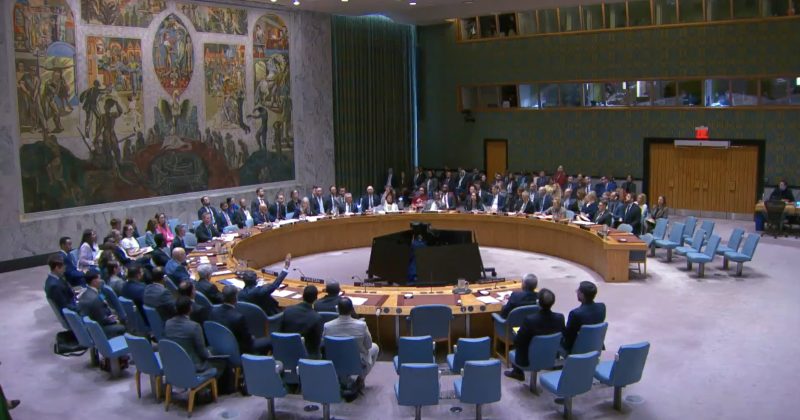
NAIROBI, Kenya, Apr 8 — The United Nations Security Council on Tuesday failed to adopt a Bahrain-backed resolution aimed at safeguarding maritime security in the Strait of Hormuz, after vetoes by permanent members China and Russia.
The draft resolution, introduced by Bahrain alongside Gulf allies—including Saudi Arabia, the United Arab Emirates, Qatar, Kuwait, and Jordan—received eleven votes in favor but was blocked by the dual veto. Pakistan and Colombia abstained.
The measure called for coordinated defensive actions to ensure safe navigation through the Strait, a strategic shipping corridor linking Iran, Oman, and the UAE. It also demanded that Iran halt attacks on commercial vessels and refrain from interfering with maritime transit.
Supporters, led by the United States and Gulf states, warned that escalating disruptions in the waterway—which handles a significant share of the world’s energy supplies—could trigger broader economic shocks and worsen global food insecurity.
Opponents argued that the draft was one-sided and failed to address the broader causes of the conflict.
“The draft resolution failed to capture the root causes and the full picture in a comprehensive and balanced manner,” said Fu Cong, China’s ambassador to the United Nations.
“The Security Council should not rush to vote when serious concerns have been raised by members.”
Russia’s envoy, Vassily Nebenzia, described the resolution as “fundamentally erroneous and dangerous,” claiming it unfairly portrayed Iran as the sole source of regional instability while omitting what he termed unlawful actions by the United States and Israel.
‘Punish the victim’
Iran’s ambassador, Amir Saeid Iravani, rejected the draft, calling it an attempt “to punish the victim” and justify further aggression.
He defended Tehran’s actions in the Strait as “proportionate measures,” assuring that non-hostile vessels would continue to enjoy freedom of navigation.
The United States struck a starkly different tone. Ambassador Michael Waltz said the Strait “is too vital to the world to be used as hostage, to be choked, to be weaponized by any one State,” accusing Iran of threatening global stability and criticizing China and Russia for siding with Tehran.
Pakistan, which abstained, called for restraint and renewed diplomacy. Ambassador Asim Iftikhar Ahmad noted ongoing efforts, including a joint initiative with China proposing a roadmap for a ceasefire, dialogue, civilian protection, and restoration of maritime security.
Bahrain expressed disappointment at the outcome. Foreign Minister Abdullatif bin Rashid Al Zayani said the Council had failed to act decisively against threats to international waterways, warning that inaction sent “the wrong signal” globally.
The impasse underscores deep divisions within the Security Council and its limited ability to respond to escalating geopolitical crises.
China and Russia signaled plans to introduce an alternative resolution in the coming days, highlighting ongoing diplomatic maneuvering despite the deadlock.
The Security Council comprises 15 members, including five permanent members—China, France, Russia, the United Kingdom, and the United States—each with veto power.
The remaining 10 members are elected by the United Nations General Assembly for two-year terms.