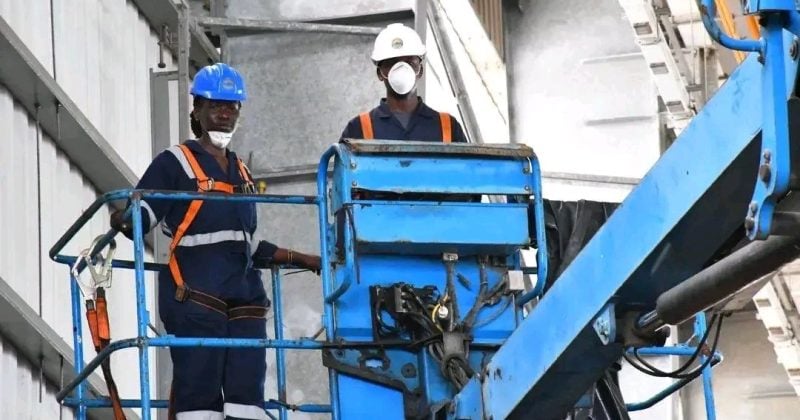
By Anne Kamonjo | Head of Greening TVET & Climate Change, Kenya’s Ministry of Education
NAIROBI, Kenya, Aug 17 – There was a time when technical competence could largely be measured by how well someone mastered a tool.A mechanic understood engines. An electrician understood circuits. A welder perfected their craft through precision and experience. A solar technician learned to install and maintain systems safely and efficiently.
These foundations remain as important today as they have ever been; what is changing however, is the environment in which those professionals now work.
I was reminded of this recently during a session I facilitated with TVET educators from institutions across Kenya. Experienced trainers. People who have given years to building technical competence in young Kenyans. When I asked how many used AI tools regularly in their teaching, a handful of hands went up. When I asked how many expected their students to work in industries shaped by AI within five years, every hand went up.
That gap, between the world our TVET institutions are preparing students for, and the tools they currently teach with, is one of the most urgent questions in technical education today.
Artificial intelligence is quietly becoming part of everyday technical practice not by replacing skilled professionals, but by changing how they learn, diagnose, plan, collaborate, and solve problems. This shift is particularly significant for Technical and Vocational Education and Training (TVET).
For years, conversations about AI have largely centred on offices, software development and knowledge work. Yet one of the most profound transformations is now taking place in workshops, laboratories, manufacturing plants, farms, construction sites, energy facilities, and maintenance bays.
The future technician will increasingly work alongside digital intelligence.
Beyond Automation
Much of the public discussion around AI focuses on automation and job displacement. While those conversations are important, they often overlook a more immediate reality.
For many technical occupations, AI is not replacing the craft. It is augmenting it.A maintenance technician may use predictive analytics to identify equipment failures before they occur. An electrical installer may use AI-assisted design tools to optimise system layouts. A construction professional may rely on digital models to improve planning and reduce material waste. A mechanic working on electric vehicles may use intelligent diagnostic systems to identify faults that would previously have required hours of manual investigation.
These are not hypothetical scenarios. The International Energy Agency has documented AI-assisted fault detection already operating in power grids and offshore wind installations, where predictive maintenance systems identify equipment stress before it becomes failure. VR-based simulation tools are already being used to train technicians for complex energy systems in environments where errors on live equipment carry safety consequences. Grid operators are using AI to optimise real-time energy dispatch in ways that would simply be impossible for a human team working from dashboards alone.In each case, the skilled professional remains central. The technology simply expands what they are capable of achieving.
And yet, the energy sector, which sits at the heart of the transition to a clean economy is falling behind in building this capacity. According to the IEA’s World Energy Employment 2025 report, the concentration of AI-skilled workers in utilities, oil, gas, and mining was on average 40% lower between 2018 and 2024 than in education, financial services, and technology. An IEA survey of energy companies found that the lack of digital skills is the single largest barrier to greater AI adoption in the energy sector ahead of regulation, infrastructure, and data availability.
The problem is not the technology. It is the pipeline.Perhaps the future of technical work is best understood not as artificial intelligence replacing craftsmanship, but as craftsmanship becoming digitally enabled. And TVET is where that enabling must begin.
Rethinking Technical Competence
This raises an important question for education. What does it mean to prepare someone for technical work when digital intelligence is becoming part of everyday practice?
Technical competence can no longer be defined solely by the ability to operate equipment. Increasingly, it also requires the ability to interpret digital information, evaluate AI-generated recommendations, exercise professional judgement, and understand when human expertise must take precedence.
AI can analyse. It can recommend. It can accelerate learning. But it cannot replace accountability, ethics, experience, or critical thinking. These remain fundamentally human capabilities.
The technician of tomorrow will therefore need to master two complementary forms of intelligence. The first is practical craftsmanship developed through experience, repetition, and hands-on learning. The second is digital fluency, the ability to work confidently with intelligent systems while understanding both their strengths and their limitations.
Together, they become a powerful combination.This evolution presents a remarkable opportunity for TVET institutions. For many years, technical education has been recognised for its emphasis on practical application. Today, it has the opportunity to become equally recognised for preparing learners to work confidently in digitally enabled workplaces.
But I want to name something honestly before I go further.AI integration in TVET is not a straightforwardly positive development to be embraced without caution. The same digital tools that can personalise learning for a trainee in Nairobi can, if poorly designed, reinforce the very inequalities that TVET exists to dismantle. AI systems trained predominantly on data from high-income, English-language contexts will not serve a student in a polytechnic in Turkana or Marsabit the same way they serve a student in a European technical college. Any AI tool deployed without a deliberate equity lens risks embedding that disparity deeper into the pipeline.And there is the infrastructure question. AI requires connectivity. It requires devices. It requires reliable electricity. Globally, fewer than 40% of lower secondary schools are connected to the internet. Many of the TVET institutions in sub-Saharan Africa that most need these tools are the least equipped to use them. The digital divide is a structural reality that shapes who benefits from AI-powered learning and who is left further behind.
This means that integrating AI into TVET is not a technology procurement exercise. It is a systems transformation that must address connectivity alongside curriculum, educator confidence alongside content, and inclusion alongside innovation.
Meaningful AI integration does not mean replacing workshops with computers. It does not mean turning every technical learner into a software engineer. It means weaving AI thoughtfully into technical education in ways that strengthen, not diminish, the value of hands-on learning, and that actively reach those who are most at risk of being bypassed.
Imagine learners using simulation before working on live equipment. Imagine trainees receiving personalised learning support based on their individual progress. Imagine instructors creating adaptive practical assessments that challenge learners at different levels. Imagine apprentices using AI to explore alternative repair approaches while still applying their own professional judgement.
That workshop evolution is already happening in some places. Our task is to make sure it happens for everyone.
Preparing Educators Before LearnersPerhaps the most important lesson emerging from global experience is this: meaningful AI integration begins with educators, not with learners.
Technology does not transform learning on its own. Teachers do.When I look at what is working in Kenya and beyond, the pattern is consistent. Institutions that have successfully integrated digital and AI tools into their teaching have not done so by purchasing software and expecting adoption to follow. They have done so by identifying, investing in, and supporting a small group of committed educators within each institution: master trainers who develop deep confidence with new tools, adapt them to local contexts, and then carry that learning to their peers.
This train-the-trainer model works because change inside an institution is ultimately peer-led. A policy directive shifts what is on paper. A trusted colleague demonstrating how AI helped her identify a struggling student, redesign a lesson plan, or adapt an assessment shifts what happens in the room.
When educators develop confidence to use AI responsibly, they are better equipped to redesign learning experiences, encourage critical thinking, personalise instruction, and prepare learners for workplaces that increasingly combine physical and digital capabilities.
It is why, in Kenya, building AI and digital capacity in our TVET educators is not a distant aspiration in our greening strategy. You cannot embed relevant, future-ready curricula through educators who have never had the structured opportunity to engage with the tools that curriculum must prepare students for.
The educator-first approach is not just good pedagogy. It is the most sustainable path to systemic change.
A New Definition of CraftsmanshipFor centuries, craftsmanship has been associated with mastery of physical tools. Perhaps it is time to broaden that definition.In my years walking the halls of Kenya’s technical institutions, as a trainer, as a mentor and as a policy leader, I have seen what happens when a learner’s skills genuinely match what the world needs. They do not just find jobs. They find purpose. They become the person in their community who can fix what is broken, build what is needed, and solve what others cannot.
That is the outcome we are building toward. Not AI for its own sake. Not digital transformation as a slogan. But a generation of technically excellent, digitally fluent, critically minded young Kenyans who walk into the workplaces of the future and are indispensable in them.
Tomorrow’s master craftsperson may be recognised not only by the quality of their hands-on work, but also by how effectively they combine practical expertise with digital intelligence.
The future workshop will still require skilled hands. It will still require curiosity, discipline, precision, and experience. But those hands will increasingly be supported by intelligent tools, better information, and faster access to knowledge.
Artificial intelligence will not define the quality of our technicians.Their judgement will. Their integrity will. Their willingness to keep learning will.This is because the future of technical education is not about choosing between craftsmanship and technology.
It is about preparing a workforce capable of bringing both together — equitably, inclusively, and with every learner in the room.Anne Kamonjo is the Head of Greening TVET & Climate Change at Kenya’s Ministry of Education and is casually known as the “Mother of Greening.” With over 30 years in the TVET sector, she leads Kenya’s national effort to institutionalise green and digital skills across technical and vocational training institutions. She works at the intersection of policy, curriculum reform, and international partnership to build an education system that is inclusive, climate-responsive, and fit for the future of work.