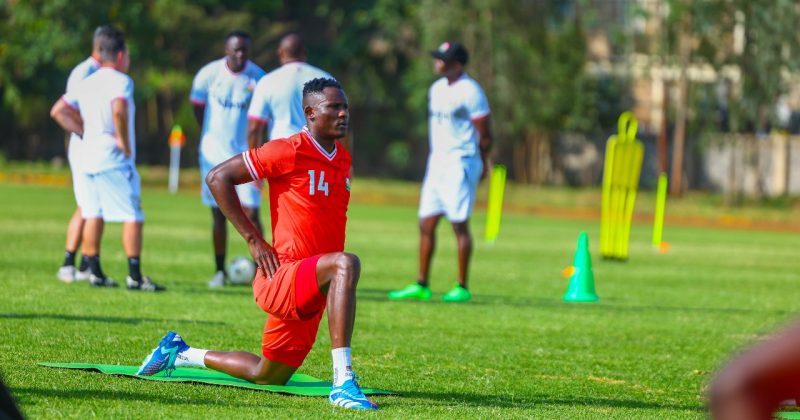
NAIROBI, Kenya, Sept 4 – On the dusty pitches of Baba Dogo, a lanky teenager once juggled between textbooks and a football.
By day, Michael Olunga wrestled with geospatial equations at the Technical University of Kenya, and by evening, he laced up his boots, chasing a dream that many thought was too fragile to survive the weight of education.
Today, Olunga is the captain of the Harambee Stars, a striker for Al Arabi AC in Qatar, and a household name across Africa, regularly known as “The Engineer” by Kenyan football fans.
But behind the thunderous goals lies a quieter triumph, that of a young man who was supported, mentored, and given the chance to believe that books and football could co-exist.
That belief now fuels his mission to give back.
Through the Michael Olunga Foundation and the Michael Olunga Football Academy, he is opening doors for underprivileged boys across Kenya, ensuring that talent is not buried by circumstance.
In just three years, his academy has produced players who represented Kenya at the U20 AFCON and earned contracts abroad.
Lessons from the journey of sports personalities like Michael Olunga, who straddled both engineering and football, highlight the gaps Kenya’s Competency-Based Education (CBE) curriculum now seeks to address. For decades, the 8-4-4 system measured success almost exclusively through exam grades, leaving little space for learners whose strengths lay in sports, the arts, or creativity. CBE, Olunga believes, is rewriting that script.
“With the introduction of CBE, it will give an opportunity to young talents, to young pupils, to young students who are coming up. If I had the CBE at a young age, I would have been in a much better place and position even to compete with fellow athletes globally. Why I say so is, you find there is potential, but this potential is normally very raw, and it is like a fine diamond. We have to make sure that the diamond is cut well,” he said.
President William Ruto has drawn praise for his deliberate investment in sport, notably through the construction and upgrading of stadiums across the country. His visible involvement during the African Nations Championship (CHAN), co-hosted by Kenya, Tanzania and Uganda, underscored his personal commitment to the sector.

“With all these facilities that will come up to support this CBE program, then for sure we will produce the next Victor Wanyama, Michael Olunga, McDonald Mariga, and there will be many more that will come out of this country. Kenya will be there globally and will compete with the big nations. We have a lot of talented kids out there, but some of them, unfortunately, come from very humble backgrounds, and they need to be supported. CBE will hopefully do that,” noted Olunga.
Adding that “Sports and art are a very big industry, not only football, athletics, drama, but everything involved. Football, sports, arts in general, they normally pay, and they pay handsomely, you know.”
Beginning January 2026, students joining senior school will choose from three specialisation pathways: Arts & Sports Science (creative arts, performing arts, and sports-related fields), Social Sciences (humanities, languages, and business studies), or STEM (science, technology, engineering, and mathematics).
“From July, Grade 9 students have already started selecting their pathways. For the first time, we are recognizing talents as part of the education system, not just exams, as they transition to grade 10,” Education CS Julius Ogamba explains.
Deputy President Kithure Kindiki ties the reforms to infrastructure: “Sports, the Arts and Creatives are now a recognized pathway in our education system. That is why we are modernizing stadiums like Nyayo and Kasarani, building Talanta Sports City, and rolling out sports academies across the counties,” he says.
For Olunga, the reform is personal. He calls talent a “diamond in the rough.” With CBE, that diamond can be cut and polished early, giving learners techniques, exposure and mentorship while they are still in school.
Olunga’s philanthropy bridges the gap between reform and reality. Growing up, he benefited from United Nations Children’s Fund (UNICEF) scholarships made possible through football. Today, he pays that forward by sponsoring nearly 100 boys in schools across Kenya.
“When a boy from my academy makes it or secures a contract abroad, it feels like scoring a goal for Kenya,” Olunga says with pride.
Through his foundation, partnerships with schools are a testament to how individual commitment, when aligned with educational reform, can change not just lives, but the trajectory of a nation.