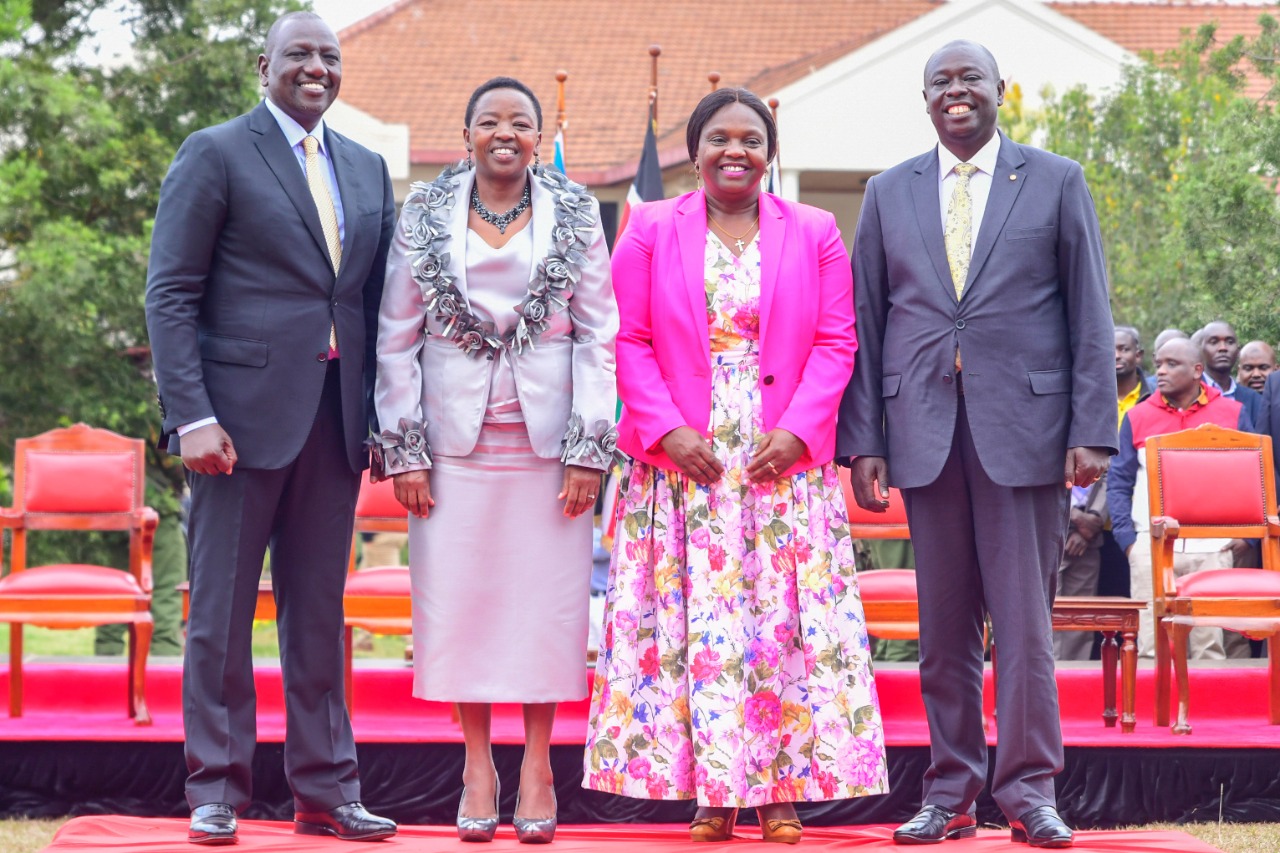
NAIROBI, Kenya, Sep 6 – The Supreme Court has thrown out a petition that sought to block the swearing-in of President-Elect William Ruto and his Deputy Rigathi Gachagua.
The petition lodged a day before the August 9 election was aimed at barring the two from being sworn-in to their respective electoral offices should they win the presidential election.
The apex court in its ruling questioned why the petitioners decided to file the petition of such “magnitude” just a day before the country went into polls and seven days before the declaration of the Presidential elections by the Independent Electoral and Boundaries Commission (IEBC).
The ruling by Chief Justice Martha Koome, Lady Justice Philomena Mwilu, Justice Mohamed Ibrahim, Justice Smokin Wanjala, Lady Justice Njoki Ndung’u, Justice Isaac Lenaola said in its ruling that the top court does not have jurisdiction on the matter.
“Therefore, the applicants are inviting the Court to assume jurisdiction outside the confines of Article 163 (3) as read with Article 140 (1) of the Constitution. They are inviting the Court to unconstitutionally expand its jurisdiction. To wait until a day to the General Elections, before seeking the Orders of such magnitude, casts the petitioners/applicants in a cynical scheme of abuse of the processes of this Court,” the court said.
Article 163 (3) (a) provides that: “The Supreme Court shall have: exclusive original jurisdiction to hear and determine disputes relating to the elections to the office of President arising under Article 140.”
Article 140 (1) on the other hand provides that: “A person may file a petition in the Supreme Court to challenge the election of the President-elect within seven days after the date of the declaration of the results of the presidential election.”
The seven-judge bench ruled that the Constitution confers upon the Supreme Court, exclusive original jurisdiction to determine disputes relating to the election of the President, “limited only to the circumstances contemplated under Article 140 (1).”
“It is not a blanket jurisdiction that empowers the Supreme Court, to extend its judicial authority over any and all interpretational questions, touching upon the election of the President. It must be further emphasized that, Article 163 (3) of the Constitution does not oust the High Court’s original jurisdiction to interpret the Constitution under Article 165 (3) (d),” they said.
The judges went further to say that the “Supreme Court’s exclusive and original jurisdiction to determine the validity of a presidential election, only kicks in after the declaration of results, following a petition challenging the election.”
In their petition, the eleven petitioners argued that both Ruto and Gachagua did not merit to hold two most powerful offices in the country in what they termed as lack of integrity virtue in Chapter 6 of the Constitution.
In response, the duo through lawyer Elias Mutuma argued the case prevents them from “doctrine of exhaustion” with regards to the avenues of recourse available on rules of procedure on settlement of disputes.