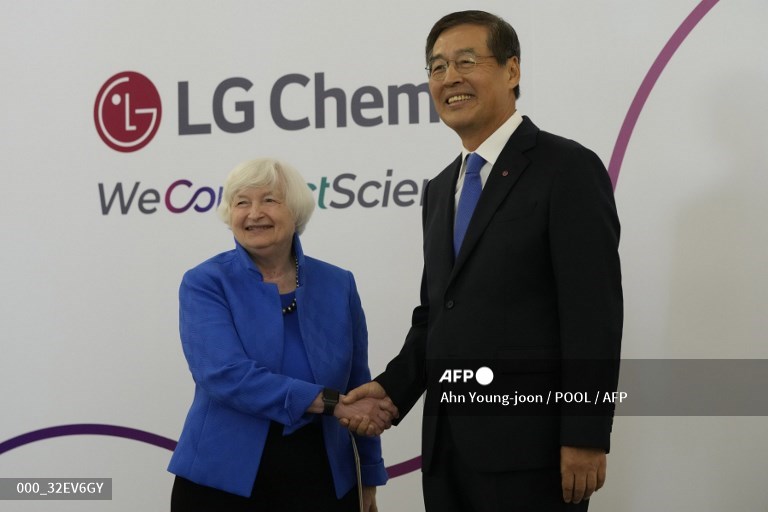
SEOUL, South Korea, Jan 16 – South Korea’s LG Chem signed an agreement with the US state of Tennessee to build a $3.2 billion cathode materials plant for electric vehicle batteries, the company said Tuesday.
The plant will be capable of producing 120,000 tonnes of cathodes a year by 2027, enough to power 1.2 million pure electric vehicles, LG Chem said in a statement.
Covering 1.7 million square metres (420 acres), the facility will be the “largest of its kind in the United States”, it added.
Cathode, a key component in rechargeable batteries, is made up of nickel, lithium and other materials, and comprises around 40 percent of the cost of electric vehicle batteries.
Tennessee was the “best choice” for LG Chem owing to its “proximity to key customers”, ease of transporting raw materials and active government cooperation, the company said.
“The Tennessee facility allows LG Chem to proactively address the changing dynamics of the global battery material market and with legislation such as the Inflation Reduction Act (IRA).”
The IRA, signed into law by US President Joe Biden in August, requires certain percentage of critical minerals used in EV batteries to be from the United States or its free trade partners.
Construction of the plant will begin next year, with mass production set to start in 2025.
The Tennessee site will “play a critical role” in LG Chem’s strategy to increase its battery materials business including cathode material fourfold from 5 trillion won ($3.7 billion) in 2022 to 20 trillion by 2027, the company said.
LG Chem’s shares ended up 0.7 percent in Seoul trading Tuesday, as the wider market fell.