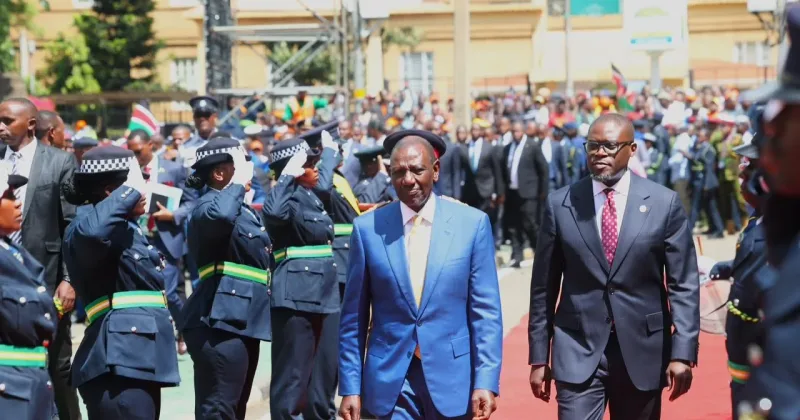
NAIROBI, Kenya July 26 – Nairobi Governor Sakaja Johnson has revealed that 2,500 officers drawn from the Nairobi County Inspectorate and the National Police Service (NPS) will undergo intensive training to establish a specialised Nairobi Metropolitan Police Unit, revealing to strengthen security across the capital.
Speaking after a church service at St. Austin’s Church in Westlands on Sunday, Sakaja said the officers will receive rigorous training tailored to the unique policing needs of Nairobi, a city whose daytime population exceeds seven million people. He said the initiative, which will be implemented under the Cooperation Agreement between the National and County governments, is aimed at shifting policing from a traffic-focused approach to enhanced security patrols and rapid response across the city.
“We will train 2,500 police officers from the county and the National Police Service. They will undergo vigorous training to address the security challenges of the city. We need more security patrols in Nairobi than traffic patrols because this is a city of seven million people with unique security needs,” Sakaja said.
The Governor further announced that Kamukunji Police Station will be transformed into the headquarters of the Nairobi Metropolitan Police Unit and will undergo rehabilitation and expansion to support its new role as the unit’s command centre.
As part of the wider security reforms, Sakaja said Nairobi will roll out an integrated citywide CCTV surveillance network linked to a new Traffic Management Centre (TMC) at City Cabanas along Mombasa Road. The multi-billion-shilling facility will serve as the city’s digital command centre, bringing together AI-powered surveillance systems, police monitoring operations and automated traffic enforcement.
He added that the system will also integrate CCTV cameras owned by private institutions and businesses to strengthen crime detection, monitoring and emergency response across the capital.
“The use of cameras will be key. City Cabanas will host Nairobi’s new digital traffic nerve hub, and we will integrate it with private cameras to improve security and enhance response to incidents across the city,” he said.
Sakaja revealed that he and the Cabinet Secretary for Interior had undertaken benchmarking visits to New York and London to study modern metropolitan policing models, saying the lessons learnt would help shape Nairobi’s new security architecture.
“We have already benchmarked in New York and London as we seek to move our country forward. One of the most critical issues in any city is security, and that is why we are implementing this under the Cooperation Agreement with the National Government,” he said.
The proposed reforms form part of the cooperation agreement between the National and County governments to modernise Nairobi’s security infrastructure, expand surveillance technology and enhance public safety in Kenya’s capital.