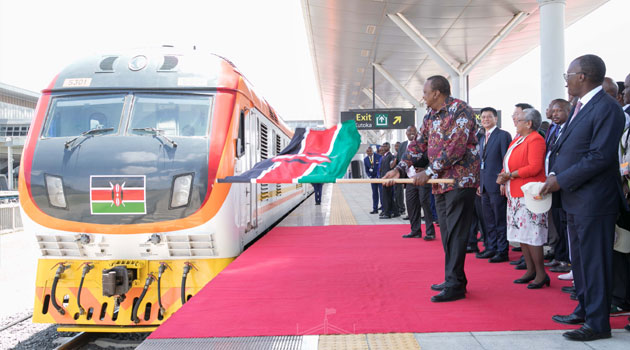
NAIROBI, Kenya, Nov 5 – Non-competitive procurement and irregularities in land acquisition contributed to the high cost of Kenya’s Standard Gauge Railway (SGR), with the country potentially spending up to $900 million (Sh116 billion) more than it would have under a cost benchmark based on Tanzania’s railway, a new World Bank report shows.
The report, Kenya Economic Update, Edition 34, estimates that Kenya could have saved up to $900 million (Sh116 billion) in initial construction costs if the Mombasa-Nairobi railway had been built at the same cost per kilometer as Tanzania’s Dar es Salaam-Dodoma line.
The World Bank puts Kenya’s SGR construction cost at $7.6 million (Sh980 million) per kilometer, compared with $5.7 million (Sh735 million) for Tanzania’s electrified railway and $5.3 million (Sh684 million) for the electrified Djibouti-Addis Ababa line.
The cost disparity raises questions about Kenya’s infrastructure procurement and project oversight, particularly as the Tanzanian railway was built several years later and to a higher technical specification, including electrification.
“With the same cost metric as the Tanzanian line, Kenya could have saved up to US$900 million (Sh116 billion) in initial construction costs.”
“Of this amount, at least 30 percent is considered attributable to governance challenges.”
The report identifies preference for direct contracting over competitive tendering, land speculation and alleged fraud involving land titling, valuation and compensation payments as some of the governance weaknesses contributing to higher project costs.
It notes that land acquisition costs were significantly higher in Kenya, although they do not fully account for the difference between the two projects.
The World Bank, however, cautions that comparing railway construction costs is not straightforward, as terrain, construction periods and project-specific requirements influence expenditure.
The report also cites a 2026 Transparency International Kenya Infrastructure Corruption Risk Assessment Tool evaluation that flagged the SGR as particularly vulnerable to corruption.
The findings come amid continued pressure on the government to improve public spending efficiency as rising debt service obligations constrain resources available for development.