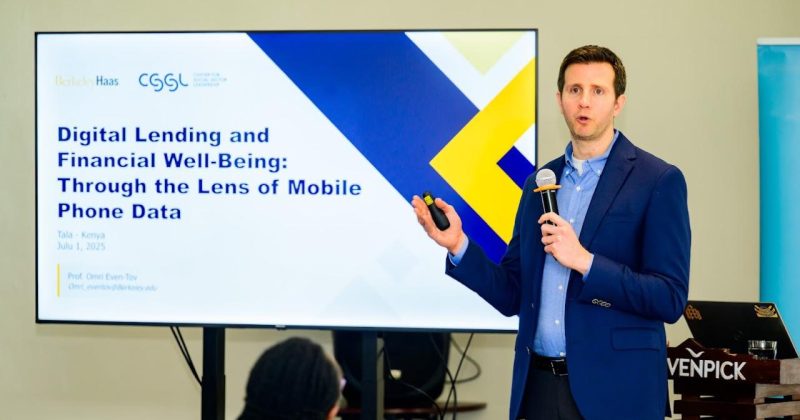
NAIROBI, Kenya, July 2 – A new study by researchers from Harvard Business School, the University of California, Berkeley, and partner institutions has found that mobile phone data can play a significant role in expanding access to credit and improving financial well-being in Kenya.
The research, titled “Digital Lending and Financial Well-being: Through the Lens of Mobile Phone Data,” analyzed anonymized data provided by digital lender Tala.
It shows that borrowers who were randomly approved for digital loans reported better financial outcomes, including higher income, greater employment, and more robust social networks.
The study involved 20,092 applicants and used mobile phone-based indicators such as monetary transactions, mobility, and self-reported employment and income to assess outcomes.
The study found that approved borrowers were 24 percent more likely to be employed or self-employed compared to those who were rejected.
They also visited 9.4 percent more cities, indicating increased economic activity, and sent 27 percent more text messages, suggesting stronger or expanding social connections.
Additionally, borrowers reported 21 percent higher monthly income and spent 15 percent more per transaction, pointing to improved financial confidence.
“These results challenge the conventional belief that low-income borrowers are more likely to misuse credit,” said Jung Koo Kang, Assistant Professor at Harvard Business School and co-author of the study.
“Instead, access to even small digital loans can open up economic opportunities and lead to measurable improvements in well-being.”
The research underscores how mobile data can be used to enhance financial inclusion in emerging markets, where many borrowers may be excluded under traditional credit scoring models.
The authors also note that the findings could inform credit innovation in developed economies, such as the United States, by highlighting the potential of alternative data in responsibly expanding access to credit for underserved populations.
Other co-authors include AJ Chen (University of British Columbia), Omri Even-Tov (University of California, Berkeley), and Regina Wittenberg-Moerman (Northwestern University).