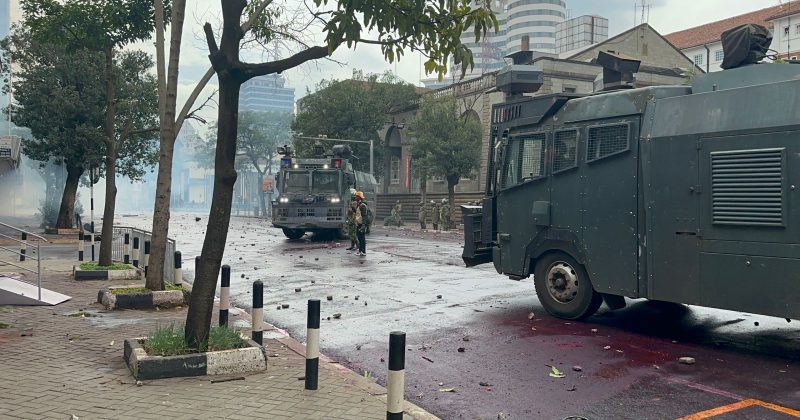
NAIROBI, Kenya, Nov 24 – A majority of Kenyans fear intimidation, arrest or violence if they participate in public protests, with new Afrobarometer findings pointing to widespread concern over police conduct, government accountability and the protection of human rights.
The survey found that 57 per cent of respondents do not feel free to participate in demonstrations without fear of repression, while only 42 per cent said they felt somewhat or completely free to protest.
“A majority of Kenyans say they fear intimidation, arrest, or violence if they participate in public protests,” Afrobarometer said in its news release accompanying the findings.
The findings highlight a sharp contrast between freedom of expression and the exercise of the right to assemble, with 65 per cent of Kenyans saying they are free to express their opinions.
The research also found that 62 per cent of respondents consider police use of force to maintain order during protests unjustified, against 37 per cent who consider such force justified.
More than half of respondents, 53 per cent, believe violence during demonstrations is mainly caused by people hired to cause trouble, commonly referred to as “goons”. Another 29 per cent blamed the police, while 16 per cent pointed to protesters.
Views remain divided on whether demonstrations should be allowed even when they sometimes turn violent. While 51 per cent support citizens’ right to protest under such circumstances, 45 per cent disagree.
The survey further raises questions about the government’s responsiveness to public grievances, with only 37 per cent saying authorities take concerns raised through protests seriously.
The remaining 63 per cent believe the government gives such concerns little or no consideration, including 31 per cent who said it does not take them seriously at all.
The findings come against the backdrop of the 2024 Gen Z-led demonstrations against the Finance Bill, which appear to have influenced public attitudes towards protests. About 51 per cent of Kenyans said the demonstrations had changed their views on using protests to influence government decisions.
Human rights and accountability
Beyond protest participation, the survey found that 53 per cent of Kenyans believe the government is not committed to protecting human rights for all citizens, compared with 42 per cent who consider it committed.
There are also concerns over the conduct of security agencies, with 56 per cent saying police often or always use excessive force against suspects in custody.
On reported abductions, 66 per cent of respondents identified the police or other state security agencies as primarily responsible, while 26 per cent blamed criminal gangs.
An overwhelming 92 per cent said the government needs to do more to investigate and prevent abductions and extrajudicial killings. Of these, 68 per cent said it needs to do “a lot more”, while 24 per cent called for somewhat more action.
Confidence in access to justice for victims and their families was also low. Only 34 per cent said they were confident that victims of extrajudicial killings and their families could obtain justice in court, against 65 per cent who expressed little or no confidence.
Concerns over the state of democracy
The survey found that 53 per cent of Kenyans had been concerned in the previous five years that democracy was under threat in the country.
Among those expressing concern, 40 per cent said they had spoken to others or shared their concerns on social media, while 29 per cent had attended meetings where the issues were discussed.
One in five said they had participated in demonstrations in support of democracy, while 19 per cent had contacted elected leaders and five per cent had reached out to the media.
The proportion of Kenyans who consider the country “a full democracy” or “a democracy with minor problems” stood at 54 per cent, down from a high of 68 per cent in 2019.
Satisfaction with the way democracy is working in Kenya has also declined, with 46 per cent saying they were fairly or very satisfied, compared with 59 per cent in 2019.
About the survey
The findings are drawn from Afrobarometer’s Round 11 survey, a pan-African, nonpartisan research initiative that tracks public experiences and assessments of democracy, governance and quality of life.
In Kenya, the research was led by the Institute for Development Studies at the University of Nairobi, with researchers Paul Kamau and Karuti Kanyinga presenting the findings at the university on November 24, 2026.
The Kenyan team interviewed 2,400 adult citizens between September 1 and 20, 2026, using face-to-face interviews conducted in respondents’ preferred languages.
The sample was nationally representative, comprising 50 per cent men and 50 per cent women, with 64.7 per cent of respondents drawn from rural areas and 35.3 per cent from urban areas.
Afrobarometer says the sample size produces country-level results with a margin of sampling error of plus or minus two percentage points at a 95 per cent confidence level. The margin of error is higher for demographic subgroups because of their smaller sample sizes.
Afrobarometer, a pan-African survey research network, launched its round 11 surveys in May 2026, building on previous rounds conducted in Kenya bewteen 2003 and 2024.