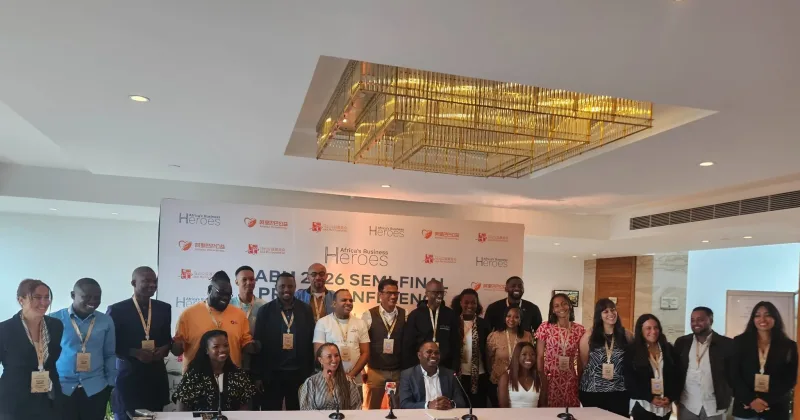
NAIROBI, Kenya Aug 20 – African entrepreneurs have been urged to build commercially sustainable businesses capable of thriving amid declining donor funding, as Africa’s Business Heroes (ABH) unveiled the Top 20 entrepreneurs selected to compete in this year’s semi-finals in Nairobi.
The finalists, whose businesses generated a combined $85 million in revenue in 2025, were selected from more than 24,000 applications across all 54 African countries and will pitch before investors, business leaders and experienced entrepreneurs on August 21 and 22, with the top 10 advancing to the grand finale in Kigali later this year.
“It forces the question that we no longer need just businesses to solve problems, but we need ones that are commercially viable, sound fundamentals, ones that can demonstrate that social impact and value around environmental protection and profits to an extent can coexist together,” said Kome Oruade-Etim, Global Programme Manager at Acumen Angels and an ABH judge.
Oruade-Etim said innovation should be designed around the realities of African communities rather than expecting communities to adapt to technology.
“How do you bring technology to where people are at as opposed to the other way around?” she said. “I see Heroes who make technology contextual to us by solving problems that are relevant for us and domesticating it in a way that makes sense to us.”
The organisers said this year’s finalists represent 12 African countries and 10 sectors, including healthcare, agriculture, manufacturing, financial services, education, renewable energy, climate technology and artificial intelligence. Together, the businesses generated about $85 million in revenue in 2025, highlighting the scale and commercial growth of African-led businesses.
Anicée Ishimwe, Senior Community Growth and Strategic Partnerships Lead at ABH, said the competition, a philanthropic initiative of the Jack Ma Foundation and Alibaba Philanthropy, seeks to identify and support entrepreneurs whose businesses are addressing some of Africa’s most pressing challenges.
“We received more than 24,000 applications from entrepreneurs across all 54 countries in Africa,” she said. “From that pool, through the different stages of judging of the competition, we have arrived here… these 20 entrepreneurs represent 12 African countries and 10 different sectors.”
Artificial intelligence also featured prominently during the discussions, with Abraham Mbuthia, CEO and co-founder of UzaPoint and the 2025 ABH first runner-up, warning that businesses which fail to embrace the technology risk losing their competitive edge.
“Businesses that adopt AI will have more clarity and will also be very competitive,” Mbuthia said during a separate interview. “Businesses that don’t adopt AI will definitely be left behind.”
Addressing this year’s finalists, Mbuthia urged them to clearly communicate the value of their businesses during the competition.
“Sharpen your story, know your numbers, articulate them clearly, and most importantly, make the judges understand your business the way you understand it,” he said. “Make it simple, make it compelling, and make it very memorable.”
He also encouraged the entrepreneurs to use the competition to build relationships beyond the judging process.
“Don’t just compete; connect. Don’t just exchange business cards; build relationships. Don’t only focus on who is sitting in the judging panel. Look around this room: your next investor, customer, partner, mentor, market entry connection, or even lifelong friends will already be part of this particular community,” Mbuthia said.
Among this year’s semi-finalists is Hagasata Rakotoson, founder of the Madagascar Guarantee Fund, which helps small businesses access credit through loan guarantees. Rakotoson said expanding access to finance remains critical to unlocking Africa’s economic potential.
“The financing is the solution in Africa,” he said. “Platforms like ABH, they give visibility for all of those entrepreneurs. And for ourselves, as a guarantee fund, this is also the way to show that there is a solution in Africa, and it’s a Pan-African solution.”
Rakotoson said small and medium-sized enterprises remain closest to local markets and are well placed to drive economic growth.
“SMEs is on the real life. They know the market, they know how to struggle. All the SMEs in Africa should be African business heroes,” he said.
Wandia Gichuru, co-founder and CEO of Vivo Fashion Group and one of the competition’s judges, said entrepreneurs would also be evaluated on whether their businesses have the potential to grow beyond their current markets.
“The scale of the business matters. Is this something that you’re building that can be taken much wider, much further? Can it go beyond the borders that you’re in now?” she said.
Kenya has four entrepreneurs among the Top 20 finalists: Ikechukwu Arthur Anoke of Zuri Health, Naomi Monari of Bena Care, Joseph Mungai of AceleAfrica and Louisa Gathecha of Bottle Logistics East Africa. The remaining finalists come from Egypt, Nigeria, Morocco, Ethiopia, South Africa, Rwanda, Tanzania, Benin, Côte d’Ivoire, Madagascar and Ghana.
The Nairobi semi-finals mark the competition’s return to the Kenyan capital, which hosted the inaugural ABH semi-finals in 2019. The Top 10 entrepreneurs selected after this week’s pitches will advance to the grand finale in Kigali this December, where they will compete for a share of the programme’s $1.5 million annual grant funding, alongside mentorship, international exposure and access to investors.