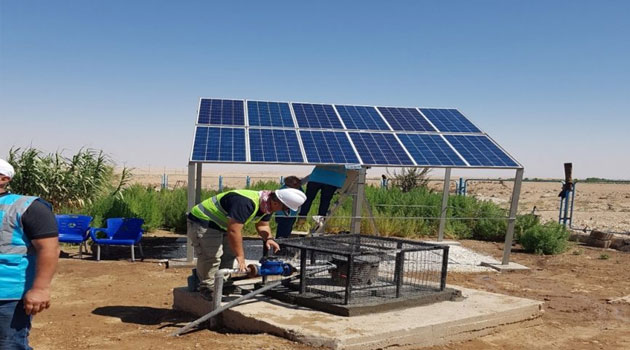
NAIROBI, Kenya, Feb 22 — A Migori-based engineer has petitioned Parliament to amend the Water Act (2016) to provide for solarized ward-based boreholes to address the perennial water shortages.
In the petition before the National Assembly, Engineer Victor Okuna proposes construction of boreholes in all the in wards across the country except the 85 in Nairobi.
Okuna said the intervention will provide a long-term solution to the biting drought in most parts of the country.
He noted 85 wards within Nairobi County and major towns should be excepted due to sewerage system considerations.
“The current water problem experienced in the country is occasioned by lack of clear water mitigation policies geared towards mitigating the crisis,” the petitioner stated.
Okuna further argued solarized boreholes will solve a myriad of challenges that have emanated from climate change including the ravaging drought affecting close to 23 counties.
House Deputy Speaker Gladys Shollei committed the petition to the Public Petition Committee for consideration. Subsequently, the committee will present a report before the House with recommendations.
Devolved Function
Among the greatest critics of the Water Act (2016) are the county governments to which the Constitution devolves water provision and sewerage services.
The Council of Governors had even moved to court to stop the implementation of the Water Act (2016), arguing that it is unconstitutional because it excludes county governments from water governance and perpetuates a centralized framework for provision and regulation of water and sanitation services.
Critics contend that the Water Act (2016) has failed to achieve its purpose, which is to provide for the regulation, management and development of water resources and water and sewerage services in line with the Constitution.
Although water is a devolved function most water resources are owned and operated by parastatals on behalf of the national government.
Proposed Amendments
Lawmakers who spoke on Wednesday welcomed the petition faulting governors for failing to decentralize funds to the wards to ensure implementation of key functions which include access to water.
MPs however stated that there is need to amend the Water Act (2016) to align it to the Devolution Act on the structures of water delivery to wards.
Funyula MP Wilberforce Oundo supported the petition terming it timely due to the water shortage crisis affecting several counties in the country.
He noted that despite water being a devolved function, citizens have continued to face challenges in accessing the basic commodity a decade after devolution.
“Many Kenyans believed that with devolution some of these mundane issues were going to be resolved but unfortunately ten years after we still have nagging water problems in many parts of this country,” Oundo said.

Decentralized funding
Nominated MP John Mbadi challenged Governors to decentralize funds allocated to them to the ward units to facilitate the implementation of devolved functions.
“When I was an MP I was using CDF money to initiate water projects in schools. I don’t understand why this issue is coming to Parliament because we vote money to counties and functions that are devolved are not being implemented,” Mbadi said.
“I want to urge the counties to devolve the funds that we give them further by decentralizing funds further to ensure services are implemented,” he added.
Mandera North MP Bashir Abdullahi mentioned that the petitioner’s proposal will go a long way in cushioning Kenyans in Arid and Semi-Arid areas.
“This House should rise to occasion and discuss drought as a matter of emergency. I appreciate the fact that the Water Act is actually outdated and we will make sure the act is updated,” Abdullahi stated.
Hostile regulatory regime
Kilifi North MP Owen Baya pushed for the collapsing of the several water parastatals which he said frustrate the construction of private boreholes.
He also called for the streamlining of licensing requirements by repealing multiple levies which he termed as hostile.
“I ask myself what the role of WARMA is to ensure there’s water in this country or just to look for money through borehole drilling. We need to collapse all of them and have one agency that serves the purpose,” said Baya.
Kangundo MP Fabian Kyule called for the slashing of the budget by the National Government meant to facilitate the drilling of boreholes in various parts of the country.
He instead proposed construction of pipelines to supply water from bulk sources.
“We have issues of drilling of boreholes and dams and I think it’s high time we solve this nonsense of drilling boreholes and dams. We need to cut all the budget and give to the military and bring all the water in Lake Victoria and pump it to the whole country,” said Kyule.
His counterpart from Turkana Central, Joseph Emase, called upon the government to harness the aquifers in Turkana County which can help alleviate water shortage in the drought affected county.
“One of the largest aquifers in Loikitipi in Turkana West can be able to serve Kenyans for more than 70 years. We have more than 5 aquifers and if they can be harnessed then we can have adequate water for the whole of Kenya,” said Emase.
Water Crisis
Growing water demand has fueled water scarcity which has aggravated food insecurity in the country.
Climate change, population growth, urbanization, water pollution, and poor management of water resources have aggravated the crisis affecting economic activities, food security, education and health.
Large populations of women and children are projected to spend up to one-third of their day fetching water from distant fresh water source.
These challenges are especially evident in rural areas and urban slums where access to piped water infrastructure is significantly law.