NAIROBI, Kenya, Nov 26 – First Assurance Company Limited has teamed up with healthcare providers and leading pharmaceutical companies to pilot an integrated healthcare model aimed at lowering treatment costs and expanding access to locally manufactured medicines.
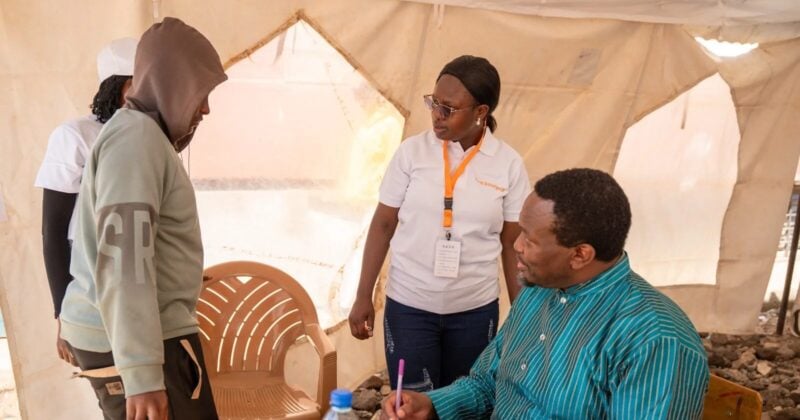
The initiative was put into action on November 14, 2026, during a community medical camp serving residents of Riruta and Kawangware. The outreach reached up to 620 patients with general outpatient, maternal, child health, dental, and optical services, while deploying medicines supplied directly by Kenyan pharmaceutical manufacturers Cosmos Pharmaceutical and Universal Corporation Limited.
The partnership seeks to solve a persistent challenge in Kenya’s health sector: the disconnect between local drug production, clinical prescribing, and health insurance financing.
“True healthcare transformation happens when we stop operating in silos,” said Johannes Kitaka, Chief Operating Officer at First Assurance Company Limited, said.
“By bringing payers, healthcare providers, and local manufacturers to the same table, we are creating an ecosystem where quality care is both clinically sound and financially sustainable for the everyday Kenyan,” he added.
Despite national policy ambitions to establish Kenya as a regional pharmaceutical hub under the Universal Health Coverage (UHC) agenda, local manufacturers remain underutilized.
According to the Kenya Pharmaceutical Industry Diagnostic Report 2020, domestic firms supply only about 30 percent of Kenya’s $1 billion pharmaceutical market. Further data from the Kenya Health Products and Technologies Local Manufacturing Strategy 2026–2030 indicates that local plants operate at just 40 to 60 percent of their installed capacity due to procurement bottlenecks, delayed payments, and market competition.
Under the new three-way framework, insurers move beyond passive claims reimbursement to actively shape demand through benefit design and provider networks. In turn, healthcare providers gain reliable supply chains at manageable procurement costs, while manufacturers receive predictable demand that enables them to scale production and price drugs competitively.
“When patients and clinicians interact directly with locally manufactured products in a trusted clinical setting, it builds confidence in domestic brands,” said Jane Ngugi, Health Economist and Financing Specialist at First Assurance General.
“Our goal is to create a seamless flow of data, accountability, and quality assurance across all three players so that local manufacturing directly translates into affordable care at the bedside.”

Insights gathered from the Riruta medical camp regarding local disease burdens and affordability barriers will now inform targeted pharmaceutical access programs, with a primary focus on non-communicable diseases (NCDs).
As chronic conditions drive up long-term medical claims, First Assurance plans to share anonymized population health data and demand forecasts with its manufacturing partners. This market intelligence will allow drugmakers to optimize production runs, prevent stockouts, and pass economies of scale on to patients.“Data-driven collaboration is the missing link in managing chronic care,” Ngugi added.
“When insurers share demand insights with local manufacturers, it lowers production costs and reduces claim expenses—allowing chronic disease patients to access lifelong treatment within their insurance benefits without financial strain.”
Industry observers note that if scaled nationwide, the model could significantly reduce out-of-pocket medical expenses for Kenyan households while strengthening domestic pharmaceutical manufacturing.