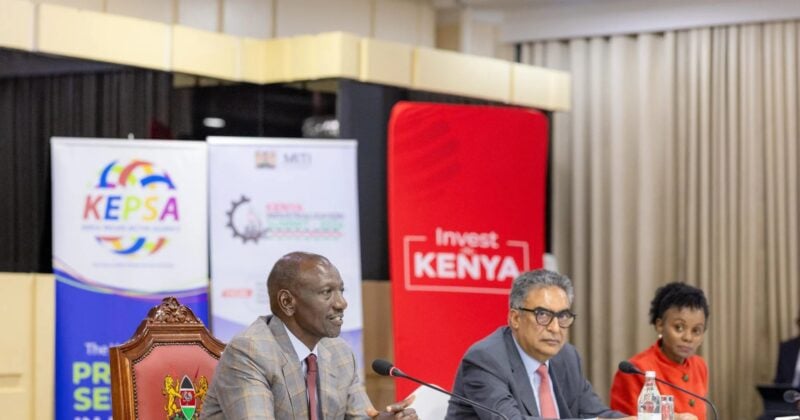
NAIROBI, Kenya, Nov 5 – President William Ruto has announced that the government is in the final stages of establishing an Industrialisation Fund that will provide manufacturers with loans at single-digit interest rates in a fresh push to accelerate local production and attract investment into the sector.
The proposed fund is expected to offer financing ranging from Sh5 million to Sh20 million initially, with the government planning to progressively increase the lending capacity to Sh100 million and Sh200 million to accommodate businesses operating at different scales.
Speaking during the ongoing Kenya Industrialisation Summit in Nairobi, Ruto said the initiative would address financing constraints facing enterprises seeking to establish or expand manufacturing operations.
“We are in the final stages of creating an industrialisation fund. That will now lend money at single digits to enterprises that want to engage in manufacturing,” he said.
“We will start with Sh5 million, Sh10 million, Sh20 million, and gradually see how we can take it to Sh100 million and Sh200 million.”
The President, however, did not disclose the proposed fund’s initial capitalization, funding sources, implementation timeline or the criteria that businesses will have to meet to qualify for the loans.
He also announced plans for a Green Investment Fund targeting $200 million (Sh25.99 billion) in capitalization, although details on its financing structure and operational framework were not immediately provided.
The proposed financing facilities come as Kenya seeks to expand manufacturing’s contribution to economic output, create jobs and reduce reliance on imported goods.
According to the Kenya National Bureau of Statistics’ Economic Survey 2026, manufacturing contributed 7.1 percent to gross domestic product in 2025, down from 7.3 percent in 2024, highlighting the challenges facing the government’s ambition of raising the sector’s contribution to 20 percent by 2030.
Manufacturing output grew by just two percent to Sh3.8 trillion during the year, reflecting subdued expansion amid high operating costs and competition from imported products.
The World Bank has previously identified limited access to capital, infrastructure gaps, unreliable and expensive electricity, and regulatory challenges as constraints to manufacturing competitiveness in Kenya.