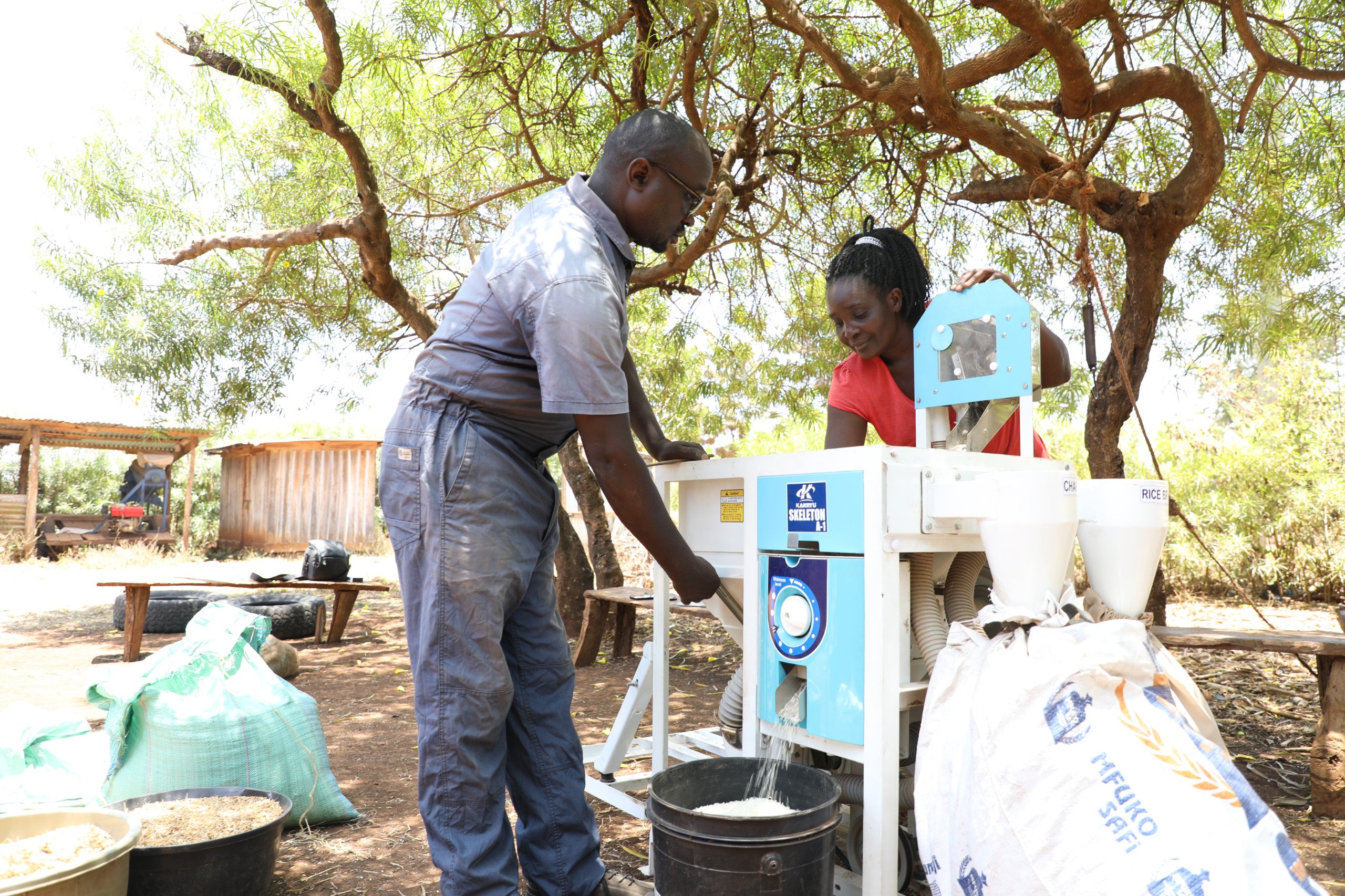
NAIROBI, Kenya, Nov 8 – Small-scale rice farmers in Embu, Meru, and Tharaka Nithi Counties now have access to portable rice milling machines, eliminating the need to travel long distances for milling.
Previously, these farmers faced high transport costs, poor rice quality, and high milling fees.
The introduction of this portable technology is changing rice production in the region, creating opportunities for farmers to enhance their produce’s value.
“The smaller machine has been such a game changer for us. Before, we had to take our rice to Mwea, about 130 kilometers away,” says Adelina Munywa, a farmer in Meru County.
“Transport costs were high, and millers retained byproducts like bran and husks.”
The machine mills in two stages, producing brown rice and husks initially, and white rice and bran in the second stage.
This improves the final product’s quality and provides byproducts that are economically valuable, increasing farmers’ earnings and reducing post-harvest losses.
“This season, I planted a small trial crop. With the portable mill available, I can mill even small quantities,” says first-time rice farmer Joel-Mark Kiania from Tharaka Nithi.
While Kenya’s traditional rice-growing regions, such as Mwea and Ahero, produce rice, domestic output has been insufficient to meet demand.
The Kenya National Bureau of Statistics (KNBS) reports an annual consumption of over one million metric tonnes, while local production is around 230,000 metric tonnes.
In 2023, Kenya spent Sh54.7 billion to import 937,098 metric tonnes to bridge the deficit.
To address the shortfall, Kilimo Trust, in collaboration with the Kenya Agriculture and Livestock Research Organisation (KALRO) and Egerton University, has been promoting upland rice varieties.
These varieties grow on dry soil, require less water, mature faster, and can be intercropped, making them cost-effective for small-scale farmers.
“Rice milling machines are expensive, and many are hesitant to invest in large-scale facilities without sufficient paddy,” said Kilimo Trust Program Officer Andrew Kasera.
“Our partnership with Kilimol provides smaller, portable machines, which are practical for small-scale farmers and encourage rice farming growth.”
The machines are available for purchase or rent, making them accessible to smallholders. “With our smaller machines, farmers can mill quantities as low as one kilogram,” says Simon Warui, Project Manager at Kilimol.
Kilimo Trust’s Reduce, Reuse, Recycle Rice Initiative for Climate Smart Agriculture (R4iCSA) aims to support 10,000 smallholder farmers in Kenya and Uganda, increasing production while promoting sustainable practices to mitigate climate change impacts.