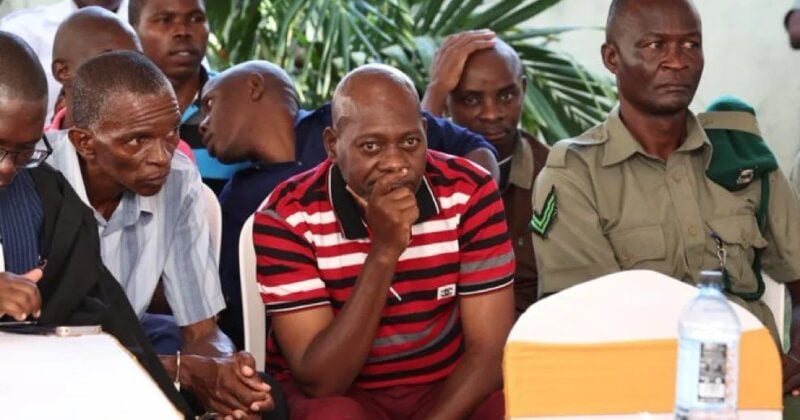
NAIROBI, Kenya Oct 19 – The High Court has convicted all 29 accused persons in the Shakahola starvation cult case linked to self-proclaimed pastor Paul Mackenzie, finding them guilty of the murder of 191 people, including 190 children.
The judge, Diana Kavedza, said the sentence would be delivered in open court on Friday, November 6, with the convicts to be physically produced in court.
In its judgment delivered on Monday, October 19, the court rejected the defence argument that the victims, all but one of whom were children below the age of 16, had voluntarily fasted to death.
“I am satisfied that the prosecution has proved the case against all the 29 accused persons for the murder of 190 children and one adult contrary to Section 203 of the Penal Code,” the court ruled.
“I reject the defence by the accused persons that the victims, who were all below the age of 16 years, voluntarily fasted to death.”
The court subsequently found all 29 accused guilty and convicted them under Section 322 of the Criminal Procedure Code.
Mackenzie was among those convicted on all 191 counts of murder, alongside the other accused persons. One of the accused pleaded guilty to all the counts and was convicted on his own plea, with sentencing pending.
The case stems from the Shakahola tragedy in Kilifi County, where followers of Mackenzie’s Good News International Church are believed to have died after being subjected to extreme fasting practices.
Mackenzie, the founder of Good News International Church, has been at the centre of investigations into the deaths of hundreds of people whose bodies were discovered in mass graves in Shakahola Forest, Kilifi County, in April 2023.
The court directed the Probation and Aftercare Services to assign each convict an individual probation officer to prepare pre-sentence reports. It ordered that no probation officer should interview more than one convict.
The reports will be presented in court on October 30, after which the defence will make mitigation submissions ahead of sentencing.
The court also noted that it had received 68 victim impact statements from probation officers across the country. The judge said the statements had already been taken and would not be repeated, leaving mitigation as the remaining stage before sentencing.
The High Court has found controversial preacher Paul Mackenzie guilty of radicalising his followers through extremist religious teachings that contributed to the deaths of 429 people in the Shakahola forest tragedy.
The ruling marks a significant development in one of Kenya’s deadliest cult-related cases, which exposed the dangers of religious extremism and the manipulation of vulnerable followers through distorted religious teachings.
Documented deaths
The Kenya National Commission on Human Rights (KNCHR) documented 448 deaths in its Mashaka ya Shakahola report released in March 2024, while more than 600 people were reported missing.
The commission said fewer than 10 per cent of the bodies had been identified and handed over to families for burial.
The discoveries triggered a major search and exhumation operation, with forensic teams working to identify the victims and establish the circumstances surrounding their deaths.
In its investigation, the KNCHR found that the deaths were linked to starvation, strangulation, head injuries and dehydration, citing autopsy findings alongside accounts from survivors and witnesses. It also criticised state agencies for failing to act on earlier warnings about Mackenzie’s activities.
The prosecution has argued that the accused were involved in a common plan that led to the deaths. doubt.
In April, Justice Kavedza ruled that Mackenzie and his co-accused had a case to answer, directing them to present their defence.
The April ruling meant the prosecution had established a prima facie case, a key threshold for further proceedings.
The trial featured testimony from survivors, relatives of victims, investigators and forensic experts. Evidence included postmortem findings and other material gathered during investigations into the deaths.
Prosecutors also relied on the doctrine of common intention, alleging that the accused acted together towards a shared objective. The defence was subsequently heard before the court reserved its judgment.
Beyond the criminal proceedings, the Shakahola tragedy prompted wider scrutiny of religious organisations and the state’s response to allegations of harmful practices.
Investigation findings
Subsequent exhumations uncovered hundreds of bodies, with forensic investigations indicating that starvation was the leading cause of death in many cases. Other victims showed signs of strangulation, suffocation and physical violence.
Investigators alleged that Mackenzie used his position as a religious leader to persuade followers to embrace extreme teachings, including rejecting food, medical treatment and formal education.
The prosecution maintained that the teachings were part of a broader system of radicalisation that isolated followers from their families and exposed them to conditions that ultimately led to widespread deaths.
The discovery of the mass graves prompted extensive investigations involving police officers, forensic specialists, pathologists and other government agencies.
The tragedy claimed the lives of numerous children, raising serious concerns over the protection of minors from religious exploitation and harmful practices.
In a separate murder case, Mackenzie and his co-accused faced 191 counts of murder linked to victims whose bodies were recovered from Shakahola. The victims in that case were overwhelmingly children.
Prosecutors alleged that children were subjected to starvation under the influence of the extremist teachings and that adults responsible for their care failed to protect them from the fatal practice.
The case has drawn attention to the vulnerability of children within closed religious communities, particularly where leaders discourage access to medical care, education and outside assistance.
The investigations into the Shakahola deaths resulted in multiple criminal proceedings against Mackenzie and other individuals accused of participating in or facilitating the activities of the religious group.
The suspects have faced various charges relating to radicalisation, organised criminal activity, terrorism-related offences and the deaths of followers.
In April 2026, a court ruled that Mackenzie and 95 co-accused had a case to answer in proceedings concerning organised crime and radicalisation, allowing the case to proceed to their defence.